Showing posts with label #blackhistorymonth. Show all posts

Friday, February 24, 2023

Novice Audiences In Schools - You Got This!


source


It is February! We have come to the month on the calendar in the United States where we go out of our way to honor, learn about, and celebrate the African Americans who have contributed to our country. We don't always do it the rest of the year, but one time in the year we are encouraged to deal with our history and the black people who have been part of it.


February is an interesting month for black performers.  I always joke that even organizations that didn't know they needed any performer ever - suddenly need a black one.


What it means is that I don't tend to work in my regular venues. Organizations that fund programming for underserved rural schools or schools with majority-minority populations that rarely have funding for anything extracurricular get angel money to have a program.

So, I often rock up to a school that has no culture of encountering a live performer, and they are now going to have some storytelling. 

Sometimes these performances are spectacular as you share with a group of people who have never seen a live performer this close or at their school and they fall in love with the possibilities. I have been in many situations like this where I walk away and the school is not only trying t figure out how to get me back, but they are ready to find ways to bring other cultural arts experiences to their kids.

Sometimes I end up in a strange encounter where the audience refuses to engage with me. There are so many factors that affect my ability to reach an audience. I typically walk away from these experiences reviewing the choices I made and considering how to make more successful choices in the future.

Every encounter is a learning experience for everyone.
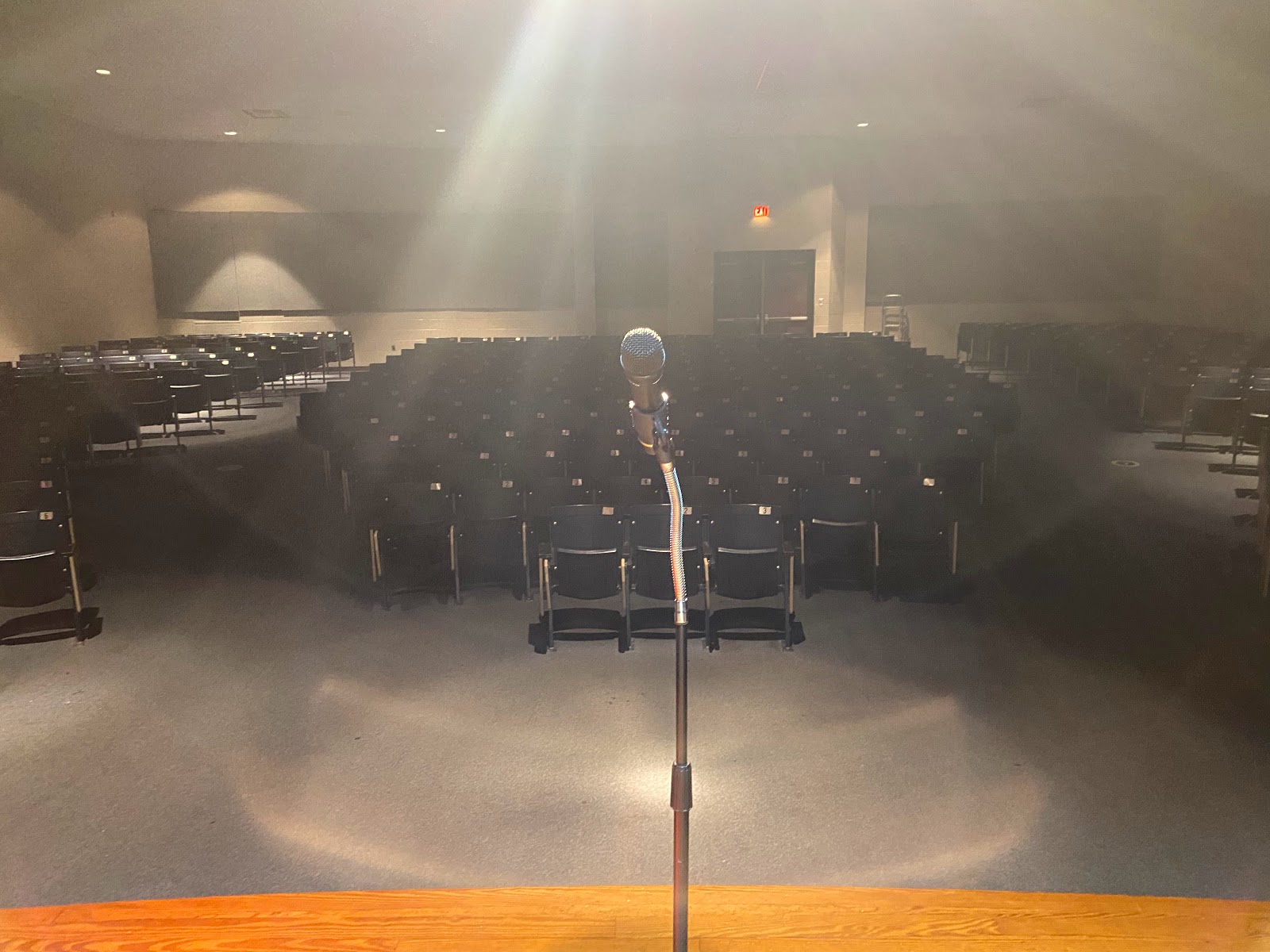
I was in a Prek - 1 set with a group of live performance newbies, and I was doing a piece called Silly Annabelle. At some point, Annabelle - who everyone calls "Silly Annabelle" because nobody appreciates her differences - has to put magic dragon shrinking powder on a dragon's nose. She gets out there to where the dragon lives and he is huge and scary. She hides behind a tree.

She asks herself out loud for the benefit of the listeners, "What am I doing here? I am so small, and he is so big! What was I thinking? if the grown-ups couldn't figure this out, what can I do? Everyone was right. I'm too small." 

When I got to that point in the story, a little PreK boy sitting in the front shouted, "YOU GOT THIS, ANNABELLE!"

In all of my years telling this story, I have watched kids respond in lots of different ways. Sometimes they cheer when Annabelle finds a solution. Sometimes they laugh as Annabelle sprinkles the powder on the dragon's nose. Sometimes they look scared as she approaches the dragon. 

That was the first time any kid yelled out emotional support for Annabelle when she was struggling with whether or not to keep going.

I love that kid. He gave me the strength to keep going! Even now as I sit down to write this I am grinning.

One of the keys to working with novice audiences is learning what works best for their school. Since it is the first time for everyone, sometimes it takes a bit to work out the kinks.

Sometimes the teachers have told their students that they must not make any noise upon pain of death before they come to the assembly. Sometimes teachers tell them nothing and just decide they are no longer on the clock the second they get into the assembly. They spend the time chatting and not doing discipline or anything else. The kids know they are "free" and some groups act accordingly and just take over the space with no consequences. 

Here are some tips for working with novice audiences in a school setting:


1. Asking Questions of the Audience to engage them. Establishing some kind of relationship with the audience before you begin. Find out about them before you begin telling them stories.

2. Check in with the audience over the course of the story by raising hands or getting suggestions. 

3. Encourage the educators in the room to participate as well. (If the educators are talking and having a grand old time during the performance and they are not participating or paying any attention to you or the kids...well, there isn't much you can do about this. Just know someone is listening!)

4. Make sure you model the behavior you want to see from the kids. Listen attentively when they ask questions.

5. Know that you are both in a learning situation, and do what you can to make sure everyone has as successful an experience as you can manage.

Over the years I have had many of these situations. Sometimes I walk away frustrated but determined as I learn something new. Sometimes I walk away triumphant after having learned something new.

Sometimes the answer to a tricky situation is as simple as changing the location of the performance.


This entire week I was in schools that have either never had assemblies, or it has been many years since they tried one.

Most of them were successful, but I had one audience I just couldn't reach. They were a small number sitting on the floor in a huge, echoing gym. It was a bad fit.

I returned to the school today, Friday, for two more small audiences. I persuaded the staff to let me tell to them in the library.

It was a much better fit, and we had great sets.

Good luck out there with the novice audience!

And remember, as I was told by that supportive 5-year-old,  "You Got This!"

Friday, February 5, 2021

I Couldn't Be Prouder - Reframing What It Meant To Be A "Slave"

 One of the things that used to cause me no end of shame and discomfort when I was in middle school and high school was the discussion of slaves in America.

There were many things they could have been called.

The Myth of the Happy Slave

Kidnapped Enslaved Africans.

People.                                 

Kidnapped Enslaved People.

Enslaved for Generations.

Denied basic humanity for Generations.

Raped, Beaten, Worked, Violated, Experimented upon, and Viewed as Property for Generations.

How was it faced in my history books?

Ha! Got you! It wasn't faced at all.

Slavery was usually dealt with using as little language and discussion as possible. The books downplayed it when it was discussed.

Oh, they said that not all slave owners were mean. They assured us that slaves were valuable and so it would not have made sense to treat them badly. Oh, yes, there were some terrible slave owners, but not all of them were bad.

I have no doubt that my classmates were telling themselves that if they'd lived in those times, they would have been "good" slave owners.  They never would have beaten their slaves.

Some probably were certain they wouldn't have had slaves at all, and I am sure some of them would not have. 

Some no doubt were certain they would have been part of the Underground Railroad, and perhaps they would have been.

What none of them took into account - mostly because our textbook didn't deal with it at all, was what the enslaved people thought of this whole situation.

Oh, and that's a thing I should discuss if you've never heard me bring it up in the past.

I would like to respectfully submit that from here on in we should always refer to the state of living for those people abducted and forced away from their homes as enslaved.

The word "slave" suggests that a person is a thing. Being a slave in the context of early American history is like a brand. It suggests that this was a natural state of being for the captured Africans. It is like that big scarlet letter. Trust me. My classmates were being told that I was a descendant of slaves.

You don't need another party to be a slave. If you are in someone's custody, they own you. Being free is not your natural or normal state.

The word "enslaved" suggests that somebody is actively doing something to you.

As opposed to saying that Africans were slaves and that is a mark against us as a people, I should endeavor to say that they were enslaved. Enslaved is an active thing. It requires an enslaver. Without an enslaver, the enslaved are free. 

I wonder what my classes would have been like if instead of talking about Southerners and "their slaves", how it would sound if we'd been taught about "Enslavers and their victims."

Substitute Enslavers for Southerners, and I suspect those kids who looked at me out of the sides of their eyes when someone said, "slaves" would have instead stared down at their textbooks and hoped I wasn't looking at them as "enslavers". I also wish the textbooks had been more clear about how truly evil it was. 

I was not the one who should have been ashamed of my ancestors in that situation. They hadn't done anything wrong or immoral.

So, just to bring the point home, this is what happened.

- The enslavers removed the youngest, strongest men women, and children from West Africa for three hundred years.

- It is estimated that over the three centuries of human devastation - fifteen to twenty million Africans were abducted from their homeland.

- We will never know how many of these people were murdered during transport from Africa to the Western World, but it is estimated to be at least one million. (Yes, murdered. The process of transporting them, and the way they were transported led directly to their deaths) - and yes, I'm still salty about this.

The Upshot?

In Africa -

For three centuries the Western World removed their youngest, strongest, brightest, and most promising people. 

Cultures collapsed -

Families were destroyed -

People lived in perpetual fear -

Progress stagnated -

Traditional ways were abandoned and lost -

The people were devastated, scattered, and traumatized - REPEATEDLY for three centuries

In America -

Imagine that you have rounded up the youngest, strongest, most able men, women, and children you could find. You put them in pens.

Some of them are not going to survive that. The strongest will. The most cunning. The ones who have the most will to live. The angriest.

Put them on ships and send them across the ocean.

Some of them are going to die. Who will survive? The strongest. The most cunning. The ones who have the most will to live. The angriest.

Now, you are on the other side of the ocean. What have you got left?

The Strongest of the strong

The Most Cunning of the cunning

The Most determined to live

The angriest damn people on the planet

The ones who were able to reach inside of themselves and find a reason to go on whether it was through music or stories or hope

That is a pretty intense group of people. 

That is the group that the enslavers in America tried to keep like livestock.

When you look at it like that, then lots of things make sense.

These were not a group of people who'd been beaten down and dominated.

This was a group of people who had figured out how to survive. 

Phyllis Wheatley - First black Poetess in America
Harriet Tubman comes from This!

Sojourner Truth comes from This!      

Frederick Douglass comes from This!

Madam CJ Walker comes from This!

Phyllis Wheatley comes from This!

All of the glorious, brilliant, determined, angry, stubborn, hopeful, beautiful black men, women, and children who have the blood of survivors running through their veins come from this!

I come from this. 

That is who I am.

And I couldn't be prouder.


I Couldn't Be Prouder - Reframing What It Meant To Be A "Slave"

Tuesday, February 2, 2021

Day 2: The historical Lens Was Cracked!


"Everyone thinks they're the good guy - no one thinks they're the bad guy. Even Al Capone thought he was misunderstood."
 - Amaryllis Fox - former undercover CIA operative

As an adult, I realize why my textbooks in history were so skewed and strange - 

The people who wrote them had a world of internal biases that were seen as "truth".


1, Western Society is the pinnacle of civilization

2. Europeans did terrible things to almost every other group of people on the planet brought civilization to every other group of people on the planet.

3. Americans are all descendant of Europeans - 

4. Americans fought the indigenous people because they were attacked.

5. Manifest Destiny was imperative. There was no other way this could have happened.


At university in a Women's Study Course, I was intrigued by the concept of "The Male Gaze".

Though the term came into being around gender issues and sexuality, I realized that it had been the main problem in my history classes! Not because of sexuality but in terms of who is looking at the scene and who is making the choices about what I learn and see.

Compound that with teaching America the Beautiful, Free, Bold and Magnificent, and the lens you are staring at history through is cracked!

How I'd Reframe It!

Instead of teaching about European cultures as if they were the obvious way cultures should develop or as if they represented "civilization" and everybody else was "less civilized" I would have liked there to be a foundation for how we talk about cultures in general. 

Why were they different?

What forces shaped them?

With that as a background for talking about different kinds of people, we could compare the various cultures as they interacted to understand why the outcomes were as they were.

It would make what happened when Europeans encountered different civilizations more understandable, and it would have given me as a student more of an appreciation for different ways of thinking about the colonization of the world. 

HISTORY REFRAMED

1. All human beings, every single person alive, your ancestors and mine came from Africa. Africa produced the first modern humans. Human beings left Africa in waves and settled all over the world. 

2. As cultures developed in different parts of the world, their environment shaped the melanin content of their skins, the way they developed languge, what they valued, how they lived on the land, what sorts of shelters they needed, what was important for survival, and how they dealt with strangers. They created different traditions, had different sacred beliefs, and made different choices about right and wrong. 


3.  For Europeans, owning and controlling land (space) became the most important commodity. Europe occupies a very small amount of land. The more land you controlled, the richer and more powerful you were. 

4.  Western European civilizations had a high proportion of herd animals that would readily accept a human as their leader. Zebras can't be ridden, Bison are hella difficult to domesticate, and will revert to "wild" behavior if startled. Western Europeans also had a very small number of large, dangerous carnivores. This is due to a fluke of latitude, and where these animals settled out after the last Ice Age. This meant that Europeans lived in close quarters with animals. A number of diseases that infect animals jumped into the European population. These zoonotic diseases became common, and the longer they lived with them, the more tolerant Europeans became of the effects.

 
(Yes, I know. This is a basic lift from Guns, Germs, and Steel, but man, I wish textbooks had used that model to teach history instead of the confusing one they had when I was a kid!)

5. Western Europeans had a very definite belief that the Christian God had chosen which people were going to be wealthy or poor, held in high esteem, or dismissed. Your status in life was Heaven Ordained.

6. When Europeans encountered other cultures, many of them were culturally and philosphically ill equipped to view these "other" peoples as full human beings or anything approaching equals. Humans in general did not know how to deal with "different" people when they first encountered them.

Why does it matter what lens we use to teach history?

The biggest problem in  America right now? Much of the suffering we are still dealing with can be traced to the last two points!


America is still a strong reflection of the Western European Cultures that settled here. We are still treating people as if they somehow "organically" matter less!

Until we face the reality that points number five and six are sung into our bones from the time we start learning the history of who we are, this fight we have between the deserving and the undeserving is going to persist.

We are also going to continually produce people who look at the length and breadth of history and say things like this from former Republican Representative from Iowa - Steve King


This man is a product of a historical perspective that told him that his gaze was the only one that mattered. He certainly doesn't think he's a bad guy. He was just trying to save America from the non-white, multi-cultural infection that he is pretty sure is destroying it.

I am also a product of that history. I'm not a bad guy. I just want to be seen.

He has no reason to question the history as it was taught. As far as he is concerned, what it told him reflects how he has lived his life.

Me? I had no choice but to reject his view of history. Otherwise, I accept that I have no place in it. 


Day 2: The Historical Lens Was Cracked!

Monday, February 1, 2021

Day 1: Telling My Ancestor's Story

 Not Everything that is faced can be changed,

but nothing can be changed until it is faced.

- James Baldwin


I loved history when I was in school. It was one of my favorite subjects. I loved learning how the various moving parts and stories intertwined to create the wild tapestry that explained why the world looks the way it does. I especially loved Medieval history and European history. 

This was not because I found European history more interesting than any other kind. No, what I have realized is that I enjoyed European history because it was the only history that actually flowed and made sense. 

I also loved ancient history. I loved reading about Ancient Greece and Rome. 

These histories were also authentic to me.

Early American history always felt uncomfortable. Lots of African and South American history felt odd. 

Looking back now, I can put my finger on what it was about learning that history that was both uncomfortable and odd.

Europeans had been fighting, killing, and dealing with each other for generations. They had respect for each other even if they didn't like each other. They recognized each other's strengths and knew their history. 

When the textbook writers wrote of English, French, Roman, or Greek history, they were solid. They wrote with confidence, and they have gorgeous, sometimes horrific, full-throated confident language that showed those people and cultures as powerful or important in their own right.

Then there was the way they spoke of Africa...

Looking back, it is clear the people writing these textbooks learned about African History from people who only knew Africa from a Western European perspective. 

We didn't learn about African people.

We learned about the "discovery" of Arica as if it wasn't there before white folks found it.

We learned about the first encounters between Africans and Europeans as if the Africans were some other species of creature.

Columbus "Discovering" America

The same thing happened with the Incas, First Nation peoples of every other continent, and their cultures. Then, when they got to how those other cultures were treated...well, it just went from bad to embarrassing. 

There was no deep telling of who these "other" people were or what they had been up to for thousands of years. 

It was as if they were bit players in the great story of white men in the world. Which, let's be honest, that is how they were portrayed in my history.

No part of history really belonged to me or my ancestors. My only real worth was as a backdrop for the great white way.

There was a paucity of blackness or color of any kind in my "official" teachings of what human history is or was or that people like me had any hand in shaping it.

It made me feel small, insignificant, and as if I had no place.

I know, I know. Some of you are thinking, "No it didn't! Children really don't think about it like that. You are projecting your adult, been through the classes, looking at the research, remembering it wrong brain on your child self!" 

Nope. 

What I remember is clinging desperately to any and all references of blackness that were even somewhat kind, strong, positive, or meaningful.

I tried so hard to find ways to be proud of what and who I knew I was, to the point of my now being able to list three things that struck me in childhood.


1) The book I brought into Show and Tell in Kindergarten. The only one I had that featured a little girl "like me". My favorite book for many years.

This is the original cover

2) The poem that was read to us in music class. I don't remember which teacher read it. All I remember is that I was in second grade. I was at Sheridan Road Elementary School. The poem was by Mary O'Neil, and it was from the book Hailstones and Halibut Bones: Adventures in Poetry and Color


Want a Copy?


The poem that stayed with me that I kept repeating over and over and over in my head for about three years? The poem that still comes back to me as an adult, but it a different way?


Here is the whole poem:

"What Is Black?"


Black is the night
When there isn't a star
And you can't tell by looking
Where you are.
Black is a pail of paving tar. 
Black is jet
And things you'd like to forget
Black is a smokestack
Black is a cat,
A leopard, a raven,
A high silk hat.
The sound of black is 
"Boom! Boom! Boom!"
Echoing in
An empty room.
Black is kind -
It covers up
The run-down street, 
The broken cup.
Black is charcoal
And patio grill,
The soot spots on 
The window sill.
Black is a feeling
Hard to explain
Like suffering but
Without the pain.
Black is licorice
And patent leather shoes
Black is the print 
In the news.
Black is beauty
In its deepest form,
The darkest cloud 
In a thunderstorm.
Think of what starlight
And lamplight would lack
Diamonds and fireflies
If they couldn't lean against Black... (O'Neill, 1960).

3) The last bit of my childhood that I clung to when thinking about finding strength was the story of Wilma Rudolph. I loved this woman's story.


Who was Wilma Rudolph


I found out about Wilma Rudolph when I was in fourth grade. I wrote essays about her as my most admired American for the next four years. She'd worn braces on her legs when she was a child. I'd worn a cast on mine when I was little because my feet and legs were not in alignment and they weren't sure I'd ever walk.

She was an Olympic medalist! She was not given a chance to walk well, and she ran! She was black! She was black like me! 

I absolutely worshipped this woman when I was a kid.

Looking back now on those three tangible facts about what it meant to be going through school as a black girl in the '70s and 80s, I am both angry and sad for that kid when I think of all of the things she could have been taught. 

I'm glad she was surrounded by opportunities, family, books, music, laughter, love, hope, and teachers who looked at her, couldn't believe she was as smart, precocious and determined as she was -

 (these were not qualities that were normally assigned to black girls when I was little - I can guess this because I was literally the only black girl in most of the work groups, study groups, and classes I had through all of my k-12 education, and I know I wan't the only smart, determined, or capable black girl in every school I attended )

and pushed her to do what even she didn't know she could do.

So, as I approached February and thought about what I'd like to do to honor black history month this year, I thought perhaps I would do some retelling.

What would I have wanted to learn about what it meant to be black in America? 

What would i have wanted to understand about what it meant that my ancestors were enslaved here?

What would I have liked to have known?

What would I have liked to have felt?

So, I am going to begin to tackle that.

I am going to spend 27 days retelling this story. 

I won't get through all of it, there are centuries of information to unpack...but I can begin with a rough outline and expand from there.

So, here we go...


Day 1: Telling My Ancestor's Story

Day 2: The Historical Lens Was Cracked!

Day 3: I Couldn't Be Prouder - Reframing What It Meant To Be A "Slave"

Day 4: A New Generation: The Teenage Social Justice Warriors


Monday, February 3, 2020

Day 3: Henry Blair - Seed Man


In 1807....

Thomas Jefferson was president -

Aaron Burr was accused, indicted, and then acquitted of treason -

The Clermont, Robert Fulton's first American steamboat, left New York City for Albany, New York inaugurating the first commercial steamboat service in the world - 

The Cotton Planter
America enacted the Embargo Act of 1807 because France and the UK were getting frisky with American citizens and goods on the high seas during the Napoleonic War -

Henry Blair was born in Glen Ross, MD.

As with many black inventors in the early 1800's, we know very little about his personal life. I suspect this is partly because he was illiterate and could leave no personal record.

What we do know is that he farmed his own land. He created two farm implements.

The Seed Planter was patented in 1834.

This resembled a wheelbarrow. The seed was in the container. As you pushed the contraption the seed would be released and then covered with soil.


The Cotton Planter was patented in 1836.
It was meant to be pulled by draft horses. Two shovel-like blades split the ground. The seeds were sown behind the shovels.

His devices were meant to make the back-breaking labor of farming a bit easier.


There is nothing in any source that I could find that suggested he was enslaved at any point in his life. He is always described as a free man who worked his own lands. 

I have seen some references that suggested he was a successful farmer, but I haven't been able to find enough information to substantiate this claim.

We know he was illiterate because he signed his patents with an "X".

He does have one special claim to fame.

He was the second African American in the United States to file and receive a patent.

A corn planter still in use


So, here is to Henry Blair! A man who was part of the legacy of farming in America...and Zambia! The corn planter in this picture is still in use in Zambia.

That is indeed a living legacy!

Celebrate Black History 

Tuesday, February 19, 2019

Day 19 - Robert F. Flemming - Guitar Man

Robert F. Flemming


Robert F. Flemming Jr.

1839 - 1919


Who Was He?


This is the trickiest inventor I have run across thus far. Not because of what he did, but because of the dispute about what he did.

So, let us get into it.

The first facts are not in dispute at all. Robert F. Flemming was born free in Baltimore, MD in 1839.

Like quite a few of the inventors I have profiled over the course of the month, he joined the Civil War effort with the Union. He was a Navy man.
source

A great deal has been written about his war record and what he was sailing on and what the various ships did.


In 1865, after the war, Flemming settled in Massachusettes. He opened a music store where he manufactured guitars and gave music lessons.

In 1900, he retired from his business and went to live in Melrose, MD. He spent the rest of his life playing music, giving the occasional lesson, and building and playing guitars for fun.


What Did He Invent?


Now we come to it...the controversy. 

Some sites credit Robert Flemming with being the inventor of the modern day acoustic guitar. The claim is that the guitars we use today are patterned after the guitar that Flemming designed and patented.

Now, the guitar has been around for a long, long time. The oldest variant we have was found in a tomb in Egypt. It is 3500 years old and was used by a musician named Har-Mose.
Har-Mose's Lute


Let there be no confusion here. Nobody is suggesting that there was never a guitar in the world, and then Robert Flemming designed and built the first one.

Honestly, if they found a 3500-year-old one buried in a tomb, these things had clearly been around long enough to have people who were aficionados of the music as well as masters at playing the instrument. They don't put any old thing in the tombs of queens. These things are going to the afterlife with them.


Source
So, if Flemming didn't invent the guitar. What the heck did he invent?


He invented a thing called a Euphonica.


As a musician and composer, he felt that this instrument had a more resonant sound than the guitars of his day.


He manufactured and sold these instruments, as well as playing them himself.

I can only assume he taught his students how to play them as well.

He received his patent for this instrument in 1886 in America and 1887 in Canada.


I have spent the last three days reading different opinions about this instrument and the information shakes out as follows:

1 - No, he did not invent the guitar, and that's all that matters. It was an ancient instrument and this does not count as a contribution to anything.

2 - No, he did not invent the guitar, this is crazy.

3 - Of course he invented the modern guitar, but because he is black, nobody wants to give him credit for it.

4 - Modern guitars are based on these designs. Before this invention, the guitars were different. (Nobody explains how)

5 - Elements of the Euphonica are still part of modern guitars.

6 - Flemming is responsible for inventing the blueprint for the modern guitar full stop.


Me? I don't play the guitar. I went on a hunt to see if I could find anybody playing a Euphonica. This became almost impossible as there are some musical groups called Euphonica, songs called Euphonica, and lots of videos of people playing the guitar, but not a single image of the above blueprint thing.

The Euphonica sort of looks like an upright bass, but the bass's history is even nuttier than the guitar.

Either way and who knows and all the same, I give you Robert F. Flemming! Inventor of the Euphonica. 

An instrument that may or may not have been the inspiration for the modern guitar.

Celebrate Black History!

Day 6 - Ernest Everett Just - Biologist, Zoologist, Cell man
Day 7 - Frederick McKinley Jones - The Coolest Man in Modern History
Day 8 - Sarah Goode - A Practical Bed For Small Spaces
Day 9 - William Henry Cling - Did He Invent The Hospital Bed Before Gatch?
Day 10 - Inez Beverly Prosser and Brown V.S. The Board of Education
Day 11 - Jan Ernst Mateliger - Mechanical Engineer/Sole Man
Day 12 - Samuel L. Kountz Jr. - Revolutionized Transplant Surgery
Day 13 - Lewis Howard Latimer - Incandescent Inventor
Day 14 - Marie Van Brittan Brown - Home Security
Day 15 - Norbert Rillieux - Sugar Man
Day 16 - Otis Boykin - He Kept Hearts Beating
Day 17 - Alice H. Parker - Heating It Up!
Day 18 - Lloyd Quarterman - Chemist and Atom Man
Day 19 - Robert F. Flemming Jr. - Guitar Man
Day 20 - Charles S. L. Baker - The Friction Radiator 
Day 21 - Granville T. Woods - The Black Edison
Day 22 - Alfred L. Cralle - Next Time You Have Ice Cream...
Day 23 - Ellen Elgin - Through The Wringer
Day 24 - Dr. Daniel Hale Williams - Holding A Heart In the Palm of His Hands
Day 25 - Benjamin Bradley - Steam Engine Dominance
Day 26 - Elijah McCoy - The Real One
Day 27 - Alexander Miles - Hold The Door, Please!

Saturday, February 16, 2019

Day 16 - Otis Boykin - He Kept Hearts Beating

Otis Boykin


1920 - 1982


Who Was He?

Otis Boykin was born in Dallas, Texas. His mother was a maid and his father was a carptenter who later became a minister.

Otis was only a year old when his mother died of heart failure.

He graduated valedictorian from Booker T. Washington High School then went off to Fisk University in Illinois.


While at Fisk, he worked as an assistant in a nearby aerospace lab. In 1941, he got a job as a lab assistant testing automatic aircraft controls.

From those beginnings, he was hired by P.J. Nilsen's lab in Illinois. 

Boykin attempted to get a higher degree at the Illinois Institute of Technology, but (depending on the source you cite)  two years he either couldn't afford the tuition, or he left because he had a job opportunity too good to resist. 

He always meant to go back for that degree, but he never did. It wasn't too great a loss. Turns out he didn't need it.


What Did He Invent?

Boykin's work in the aerospace labs and with PJ Nilsen influenced the rest of his life. Boykin's thing was resistors in electronics.

Okay, let me see if I can explain this for the non-mechanical amongst us...I'm one of them.

Resistors
The purpose of a resistor is to control a current of electricity. It can reduce the amount flowing through a circuit, split it, release the energy as heat energy to help cool things down, and anything else that would somehow change the current of electricity flowing through a circuit.

Boykin's contribution was to make very effective resistors that were cheap and easy to produce. His first patent for resistors was granted in 1959.

Why is this such a huge thing? Well, because every single electrical thing we have uses them. 
Every. Single. One.

Boykin's first resistors were excellent at splitting currents. These ended up in televisions and radios everywhere.

Two years later, in 1961, he created another resistor. This one was even cheaper to produce, very durable and could keep its efficacy despite huge changes in temperature, pressure and being thrown about and battered.

The Department of Defense put those resistors into their new generation of guided missiles and aircraft.

IBM put them into computers.

All of the nascent high tech industries of the day wanted Boykin's resistors.

In 1964, Boykin moved to Paris. He had a company called Boykin-Furth Inc. 

source


The most famous of Boykin's resistors is the one that is used in pacemakers.


This little device has saved millions of people's lives.


His Legacy?


The resistors he devised changed the world of electronics from war - military airplanes and guided missiles - to industry - IBM.

He contributed to the development of better radios and televisions.

Boykin created the resistors for a device that millions of people rely on to keep their heart regulated - the pacemaker.

This inventor saw great financial gain from his inventions and lived a comfortable life.

He died in Chicago in 1982...of heart failure. At the time of his demise, he'd accumulated twenty-six patents.


So, a big thank you to Otis Boykin for all of the hearts that are still beating that would have stopped.


Celebrate Black History!

Day 1 - The ABC's of Black History Month
Day 6 - Ernest Everett Just - Biologist, Zoologist, Cell man
Day 7 - Frederick McKinley Jones - The Coolest Man in Modern History
Day 8 - Sarah Goode - A Practical Bed For Small Spaces
Day 9 - William Henry Cling - Did He Invent The Hospital Bed Before Gatch?
Day 10 - Inez Beverly Prosser and Brown V.S. The Board of Education
Day 11 - Jan Ernst Mateliger - Mechanical Engineer/Sole Man
Day 12 - Samuel L. Kountz Jr. - Revolutionized Transplant Surgery
Day 13 - Lewis Howard Latimer - Incandescent Inventor
Day 14 - Marie Van Brittan Brown - Home Security
Day 15 - Norbert Rillieux - Sugar Man
Day 16 - Otis Boykin - He Kept Hearts Beating
Day 17 - Alice H. Parker - Heating It Up!
Day 18 - Lloyd Quarterman - Chemist and Atom Man
Day 19 - Robert F. Flemming Jr. - Guitar Man
Day 20 - Charles S. L. Baker - The Friction Radiator 
Day 21 - Granville T. Woods - The Black Edison
Day 22 - Alfred L. Cralle - Next Time You Have Ice Cream...
Day 23 - Ellen Elgin - Through The Wringer
Day 24 - Dr. Daniel Hale Williams - Holding A Heart In the Palm of His Hands
Day 25 - Benjamin Bradley - Steam Engine Dominance
Day 26 - Elijah McCoy - The Real One
Day 27 - Alexander Miles - Hold The Door, Please!