Showing posts with label Inventor. Show all posts

Saturday, February 9, 2019

Day- 9 William Henry Cling - Did He Invent the Hospital Bed Before Gatch?

William Henry Cling - 1866 - 1937


Now, before I start this, I want to be clear about something...I did not come here to throw shade.

I came to talk about a barber.

William Henry Cling was born in Charleston, SC right after the Civil War ended. He worked as a barber up until his death of a stroke in 1937.

The thing about this barber is he was also an inventor. 

I could find nothing about whether he was the sort of fellow who got home and spent all of his evenings tinkering but he seems to have been one of those self-taught mechanical engineers.


What Did He Invent?


Cling invented a couple of things that one might expect of a barber.
Clings Shoe String


Our barber also patented improvements to something called a Coat Lapel and Collar Regulator. This is a little gizmo that goes into the lining of men's coats that makes the lapel and collar fall properly on the body.


I kind of expected that sort of thing from a man who spent his life styling gentlemen. His other extracurricular activities, however, roamed far afield.


A Mechanical Man


William Henry Cling patented improvements to railroad safety. His device helped prevent head on and rear end collisions for trains traveling on the same track. 

I found some breadcrumbs that suggest this device was actually created and used on the railroads. It has an international patent at this point. 

Now, ask me if I can find any information about Cling being cited for having invented it or anybody actually using it in any literature that pertains to the railroads.

Answer: I can't. 

Possibly I don't know how to search for this information. Possibly it is in obscure books about little-known inventors who contributed something to locomotive travel? Possibly nobody cared about this and it was never used? Possibly it didn't work?


If anybody out there knows, I would be happy to learn more about this.

He also patented a mechanical device that could be used to keep track of the number of people entering or leaving a place like a fair or an amusement event. It was handheld,  you clicked it and it kept a record of whatever you were counting. Did somebody pick up this patent considering the number of mechanical tally keepers we have today?

Answer: I have no idea. 


The Gatch Bed

Then, there was the big one. 

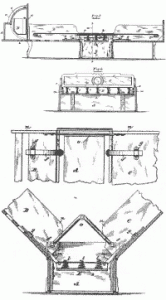
William Henry Cling designed and began the process of patenting an adjustable bed in 1908. This was to help bedridden people. His idea was that they wouldn't be stuck lying prone all of the time. They could not only sit up, but their legs could also be adjusted.  

There was an adjustable bed on the market in 1874, but only the top half could be adjusted. Cling designed and patented a bed that could be raised or lowered at both ends.  His patent was awarded in 1909.

The Gatch Bed


Turns out that in 1909, the same year Cling's patent was awarded, Willis Drew Gatch, a doctor of great renown, developed what looks like the same thing. Today, we call it The Gatch Bed.


Now, I am not saying that this doctor who did pioneering work in the field of Anesthesiology might not have designed this bed.

source


I do note that Gatch didn't design anything else mechanical, and there is nothing I could find that says anything other than he designed it.

All I'm trying to say is that if you look at the design of Cling's bed, and you look at the Gatch Bed, they look suspiciously similar.

I am certain there is a perfectly good explanation about how Drew ended up designing a bed like Cling's in the same year it appeared in the patent office. 

Convergent Inventing? It isn't like that hasn't happened before.


Anyway, I give you William Henry Cling.

An African American barber who invented some really cool stuff and doesn't seem to have been given credit for any of it.


Celebrate Black History Month!

Day 1 - The ABC's of Black History Month
Day 6 - Ernest Everett Just - Biologist, Zoologist, Cell man
Day 7 - Frederick McKinley Jones - The Coolest Man in Modern History
Day 8 - Sarah Goode - A Practical Bed For Small Spaces
Day 9 - William Henry Cling - Did He Invent The Hospital Bed Before Gatch?
Day 10 - Inez Beverly Prosser and Brown V.S. The Board of Education
Day 11 - Jan Ernst Mateliger - Mechanical Engineer/Sole Man
Day 12 - Samuel L. Kountz Jr. - Revolutionized Transplant Surgery
Day 13 - Lewis Howard Latimer - Incandescent Inventor
Day 14 - Marie Van Brittan Brown - Home Security
Day 15 - Norbert Rillieux - Sugar Man
Day 16 - Otis Boykin - He Kept Hearts Beating
Day 17 - Alice H. Parker - Heating It Up!
Day 18 - Lloyd Quarterman - Chemist and Atom Man
Day 19 - Robert F. Flemming Jr. - Guitar Man
Day 20 - Charles S. L. Baker - The Friction Radiator 
Day 21 - Granville T. Woods - The Black Edison
Day 22 - Alfred L. Cralle - Next Time You Have Ice Cream...
Day 23 - Ellen Elgin - Through The Wringer
Day 24 - Dr. Daniel Hale Williams - Holding A Heart In the Palm of His Hands
Day 25 - Benjamin Bradley - Steam Engine Dominance
Day 26 - Elijah McCoy - The Real One
Day 27 - Alexander Miles - Hold The Door, Please!

Friday, February 8, 2019

Day 8 - Sarah Goode - A Practical Bed For Small Spaces

source


Sarah Elisabeth Jacobs Goode - 1855 - 1905


What We Know For Sure


Sarah was born in 1855 in Toledo, Ohio.

After the Civil War ended, her parents moved her and her six siblings to Chicago, Il.

There, she met and married a fellow named Archibald Goode who was a carpenter.

Sarah opened her own furniture store in Chicago.

One of the major complaints her clientele had about their apartments was that they were very small, and there was barely any room for furniture.

Sarah put her mind to figuring out how to optimize the space at hand and offer a piece of useful furniture.

Her creation? A cabinet bed.

source
A desk that was fully functional with drawers and space to work that had a bed hidden in it.

You could do everything you wanted from storing paperclips to using the top of the desk to eat or do your taxes, and when you were ready for bed, you could open it and a full sized bed would unfold. There was a separate piece you could use to reinforce the middle of the bed.

source


 In the morning, you put the bed away and go on with the day.

Sarah patented the cabinet bed in 1885.

Sarah Goode died in 1905.


Things That Might Or Might Not Be True


The above facts seem to be mostly born out by all of the various sites I looked at and read. Now, there were lots of other things I found that seem either made up or fanciful, and possibly embellished.

This site says definitively that Sarah Goode was born into slavery.
Considering the fact she could read and write, that is highly suspect.


I found out there was a potential other African American woman who'd gotten a patent the year before Sarah. Her name was Judy Reed. Nobody knows anything at all about Judy Reed other than she got a patent in 1884. She signed her name "X".

I am not certain why anybody thinks Judy Reed was black.


Whilst searching for some kind of visuals for this post, I found a very "not an African American woman" picture listed with Sarah Goode's accomplishments on multiple sites.

I tracked the picture down and it turns out it is from a site for a family who was chronicling their  history in Wyoming The woman's name just happened to be Sarah Goode, but there is no reason to believe she invented anything, and she is most certainly not the first or possibly the second African American woman to ever patent anything.

I was amused that so many people had reprinted the picture without questioning it.

In Conclusion

All of that said, I give you Sarah Goode. She created the first cabinet bed that could double as a piece of functional furniture.

Sarah's creation was the precursor of the Murphy Bed, the sofa bed, and all the hideaway beds we have today.

Thank you, Sarah!

Celebrate Black History!

Day 1 - The ABC's of Black History Month
Day 6 - Ernest Everett Just - Biologist, Zoologist, Cell man
Day 7 - Frederick McKinley Jones - The Coolest Man in Modern History
Day 8 - Sarah Goode - A Practical Bed For Small Spaces
Day 9 - William Henry Cling - Did He Invent The Hospital Bed Before Gatch?
Day 10 - Inez Beverly Prosser and Brown V.S. The Board of Education
Day 11 - Jan Ernst Mateliger - Mechanical Engineer/Sole Man
Day 12 - Samuel L. Kountz Jr. - Revolutionized Transplant Surgery
Day 13 - Lewis Howard Latimer - Incandescent Inventor
Day 14 - Marie Van Brittan Brown - Home Security
Day 15 - Norbert Rillieux - Sugar Man
Day 16 - Otis Boykin - He Kept Hearts Beating
Day 17 - Alice H. Parker - Heating It Up!
Day 18 - Lloyd Quarterman - Chemist and Atom Man
Day 19 - Robert F. Flemming Jr. - Guitar Man
Day 20 - Charles S. L. Baker - The Friction Radiator 
Day 21 - Granville T. Woods - The Black Edison
Day 22 - Alfred L. Cralle - Next Time You Have Ice Cream...
Day 23 - Ellen Elgin - Through The Wringer
Day 24 - Dr. Daniel Hale Williams - Holding A Heart In the Palm of His Hands
Day 25 - Benjamin Bradley - Steam Engine Dominance
Day 26 - Elijah McCoy - The Real One
Day 27 - Alexander Miles - Hold The Door, Please!

Tuesday, February 5, 2019

Day 5 - Mary Beatrice Davidson - Inventor of the Sanitary Pad

Mary Beatrice Davidson Kenner 1912 - 2006


Who was she?

Born in Monroe County, NC in 1912

Mary Davidson was born to invent things.  Her first attempt was to make a self-oiling door so that when her mother went out the back door in the morning the squeaking wouldn't wake her.

She was six.


Mary credits her father for encouraging her to explore things. She was bright and did well in school, but had to drop out of Howard after less than a year for lack of funds.

She never got an advanced degree.

Mary holds five patents. That is more than any other African American woman in history.


What did she invent?

Mary invented a number of things that improved the lives of women and people who needed extra assistance.

Her most famous invention was a sanitary belt attached to a pocket that was moisture proof. 

She invented the belt first and patented the moisture proof pocket later.

The Sanitary belt and tissue holder.
There were not very many options for women who were menstruating back in the day. They used wads of cloth or rags, and it wasn't advisable to leave the house. There were tampons, but it was considered scandalous to use them. Mary's invention addressed the problem.

She added a cloth pouch with a moistureproof seal that attached to the belt. You put rags or cotton into the pouch. It was the pocket for padding and the moisture proof seal that made it revolutionary. Mary Beatrice Davidson had invented the first generation of what would eventually be called the sanitary pad or napkin.

It meant you could actually go out in public without fear of getting blood everywhere.

When she first patented it, a company sent a representative down to speak to her. when they found out she was black, they lost interest. It was 30 years before anyone picked up the patent and started manufacturing them.

She also designed an improved bathroom tissue holder that allowed the dangling end of the tissue to be accessible at all times. 

When her sister Mildred - an inventor in her own right -  was diagnosed with Multiple Sclerosis, Mary invented and patented a tray and carrier that attaches to a walker.

Mary also invented a back washer that attaches to the wall for people who would find it hard to wash their backs any other way.


Inventing Because It Was Fun

Mary did not make money off of any of her inventions, but she never lost the joy of making things. 


She owned her own florist business in Washington DC until her death in 2006.

Thank you, Mary Beatrice Davidson Kenner for making "that time of the month" less burdensome for women.

Celebrate Black History!

Day 1 - The ABC's of Black History Month
Day 6 - Ernest Everett Just - Biologist, Zoologist, Cell man
Day 7 - Frederick McKinley Jones - The Coolest Man in Modern History
Day 8 - Sarah Goode - A Practical Bed For Small Spaces
Day 9 - William Henry Cling - Did He Invent The Hospital Bed Before Gatch?
Day 10 - Inez Beverly Prosser and Brown V.S. The Board of Education
Day 11 - Jan Ernst Mateliger - Mechanical Engineer/Sole Man
Day 12 - Samuel L. Kountz Jr. - Revolutionized Transplant Surgery
Day 13 - Lewis Howard Latimer - Incandescent Inventor
Day 14 - Marie Van Brittan Brown - Home Security
Day 15 - Norbert Rillieux - Sugar Man
Day 16 - Otis Boykin - He Kept Hearts Beating
Day 17 - Alice H. Parker - Heating It Up!
Day 18 - Lloyd Quarterman - Chemist and Atom Man
Day 19 - Robert F. Flemming Jr. - Guitar Man
Day 20 - Charles S. L. Baker - The Friction Radiator 
Day 21 - Granville T. Woods - The Black Edison
Day 22 - Alfred L. Cralle - Next Time You Have Ice Cream...
Day 23 - Ellen Elgin - Through The Wringer
Day 24 - Dr. Daniel Hale Williams - Holding A Heart In the Palm of His Hands
Day 25 - Benjamin Bradley - Steam Engine Dominance
Day 26 - Elijah McCoy - The Real One
Day 27 - Alexander Miles - Hold The Door, Please!