Showing posts with label #storytelling. Show all posts

Tuesday, February 17, 2026

The 7th Grade Set - Stories for the Half Grown and Unwilling!


Donna Washington

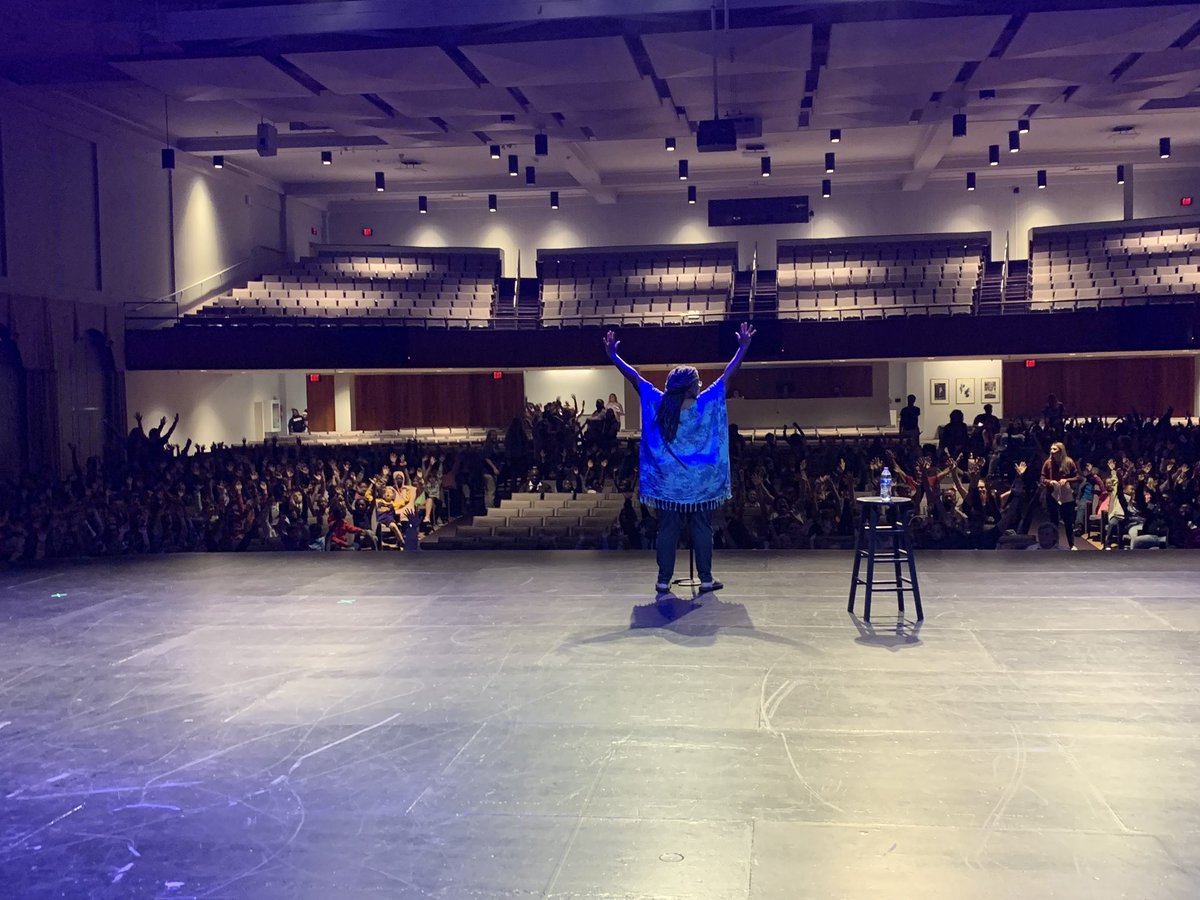
Today was an Alston Ridge Day.

I see the K - 2 in the morning at the elementary school, and then I visit the seventh grade at the middle school in the afternoon.

The littles in the morning are always fun. I have a set list that I cycle through so that every four years I start the sets over so nobody sees the same stories twice.

The seventh grade is easier. I just tell the same story every single year. I always feel a bit bad for the teachers since they see the same story

every year, but they enjoy it. They enjoy watching the kids going through the paces as the story unfolds.

This year, I was off balance. In November, I broke three large bones in my ankle. The recovery will take about a year.

Since Alston Ridge is a large year-round school, I don't see all of the kids at once. I visit some tracks in January, and the other tracks in February.

In January, when I went to the 7th grade, I didn't tell my traditional story. Instead of the Sugar Incident, I told a random set of "middle school" tales. It was successful, the kids loved it, and we had a great time. I have no idea why I told those stories. Not a clue. In fact, I barely remember telling those stories. I blame the meds. Either way, the set was a success

Today, I was back at the schools. My early set was great. We did a turn
From Shrek 3

with Rumplestiltskin.

When I got to the middle school, I decided to do The Sugar Incident, which is what a traditionally tell to 7th graders.

(When I tell in middle schools, I always request the sixth grade alone, the 7th grade alone, and the 8th grade alone. I have differfent sets for each group.)

Anyway, as the students filed into the auditorium, I clocked a handful who entered determined to be bored, disconnected, or confrontational.

The slouch.
The scowl.
The pulling of their hoodies over their eyes.
The pretending to be asleep after two seconds.
The glaring at the floor.
The perpetual sneer at the world etched in haughty lines across the features.

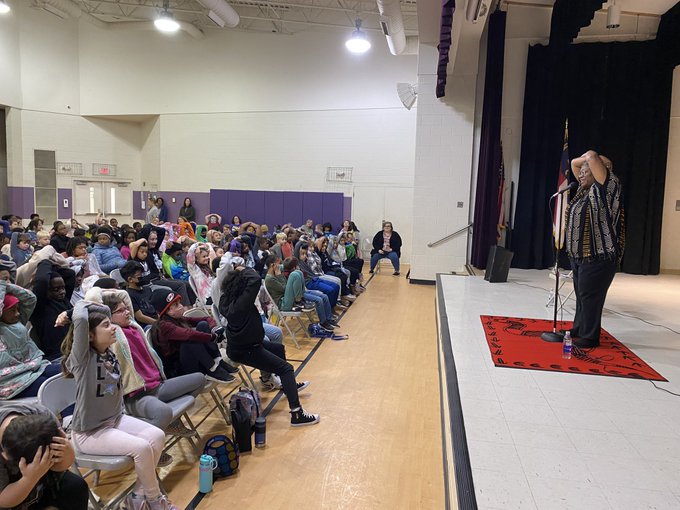
This year, because of my injury, I tell the kids why I am sitting and wearing shoes instead of standing barefoot.

Afterward, I launched into The Sugar Incident.

It was a hit. The kids were a hoot. They were the best version of a middle school audience you can get.
They gasped at the right places.

They were startled at the appropriate times.

They laughed uproariously when it was funny.

They made eye contact with kids all over the room when they raised their hands.

They built little communities in places they clearly hadn't before.

The one student who sat in the front row trying to not participate as he slouched and glared, caught himself laughing. He stopped that nonsense immediately, but by the end, he gave up and just had a good time. He even turned around to make eye contact or laugh with other kids.

It was a triumph of sharing a tale about being in trouble and being too scared to admit fault.

When the story ended - it lasts for an entire hour - the kids filed out sharing their own stories as they went back to class.

The principal, who sat through this set and the one earlier in January was pleased.

Principal - That was amazing. They were sitting on the edge of their seats.

Me: We had a great time.

Principal - This is a really difficult group, but they were wonderful.

Me - Difficult?

Principal - Yes. These are just a really hard group of kids. The other group you did a few weeks ago was also hard, but this is a really difficult group. You had them captivated.

Me - (I smile) They were great.

I explained that the key to captivating middle school audiences is that the stories should encapsulate what the kids do and who they are. These stories help build community between the audience and the
teller. They also build connections between members of the audience. We become one group, sharing common experiences. These tales make friends laugh, strangers connect, and the grumpiest kid find him/herself in the faces of kids around them.

Groups aren't "difficult" so much as they are going through their own things.

Who am I kidding? Sometimes they are difficult. Chemistry, the weather, the full moon. Sometimes it is difficult. Choosing the most appropriate stories can help.

I was a seventh grader once. I remember what it was like. The stories I tell them are about that time in life.

The things that were part of my life then....

The Washingtons in the 80's
Lying about breaking things, blaming others for your mistakes, being in serious trouble with your parents, dealing with brothers and sisters, a butt whoopin', crocodile tears, chores nobody wants to do, doing stupid things, being annoyed by other people's inconsiderate actions, grumpy parents, and being too scared to admit something. Being the "good kid". Being the "bad kid". Homework. Then there is the whole problem of being a bottomless pit of hunger.
These are all things any 7th grader can relate to.
source
Humans are not unicorns. Not even seventh graders. Especially not
seventh graders.

I explained all of this to the principal.

Principal - (nods) You could see them connecting across the room. Usually, these kids are just so mean to each other and disrespectful, but you wouldn't have known that watching them when you were telling. They were so wonderful.

All I could think was that our kids need more opportunities to see themselves in each other.

We need more communal storytelling.

Our children need more stories.

We can't raise all of them.

We can't fix the problems they face.

We can't force them into introspection.

What we can do is put them in situations where they feel shared humanity.

We can give them opportunities to see each other as peers.

We can help them laugh, think, consider, and anticipate.

We can't do anything about puberty.

What we can do is give them stories to get through it.

The better we are at finding stories that help audiences connect with us and each other, the stronger bonds we can build.

Happy choosing the best tales!


Saturday, November 8, 2025

A Week In The Life!


This week was a great example of what it is like to be a professional
storyteller. It is perfect. It had all of the elements of the job over the course of six days. So, if someone asks what we do, here is a great snapshot.

Monday 

On Monday, one of the marketing activities we do took place. It is called Arts Market, and is run by the North Carolina Presenters Consortium. 

It happens every year at the Durham Convention Center in downtown Durham, NC. Artists from as far away as California, Canada, and Europe come to court venues from Florida, South Carolina, North Carolina, Virginia, and Georgia. 

Whenever possible, Dave and I buy a double booth. We have lots of merch, and we like to have room to spread everything out on the table, and make sure we have a welcoming place for folks to sit and talk.

Spent the day going over my speech for the opening dinner.

I was the keynote speaker. The artists and presenters were there for it, and together, we burnt the house down. It was one of those "the arts are essential, don't let the atmosphere in the country get you down!" 


Tuesday 


Still at Arts market! Shaking hands. Meetings. Smiling until my face hurts. Oh, and there was another black lady there with dreads, so you

Twins!

gotta know that half of the people at the convention kept telling her they really loved her speech. Yes, this is part of being a teller. Sheila Arnold and Diane Ferlatte know of what I speak!


Wednesday


Still at Arts Market. Tired. Still smiling. Not much action today. Anyone who wanted to talk to me about possible work chatted with me yesterday. Today is for the last of the showcases. Still, gotta be there until 2:15.

Mango Lassis
After gathering our things and returning home, I had to go over my notes for my trip to Wilmington. Refreshing my memory about the Cameron Arts Museum, choosing material for my shows, and making
sure I have everything I need for my workshop on Saturday.

7pm - Closing Dinner at an Irish Pub where Carolina Quiroga talked us into doing the trivia game, got to talk to a re-enactor from Canada named Leslie, and hanging out with Lucas Vandergriff.


Thursday 

Packed. Drove to Wilmington, NC. Located dinner. Spent the evening familiarizing myself with the new material I needed to present on Saturday.


Friday

Performance at what used to be the Black school in Wilmington, NC. Their history is varied and intense. I was speaking at the venue that Martin Luther King was supposed to visit. He had been scheduled to appear on April 5, 1968...the day after his assassination.

Williston Middle School

I performed for 200 eighth graders. The organizer, September Krueger, was shocked. Her response? "You had 200 kids in there - and all that quiet!"

This reaction that makes me want to ask if they assumed they were feeding me to the wolves! 

Spent the rest of the day driving around Wilmington looking for good Gluten Free options. This time around I found Playtpus and Gnome.

Elk Burger - Platypus and Gnome!

DELICIOUS!

Saturday

One show at the Cameron Arts Museum. Monday? Over one hundred folks hanging on my every word. Friday? Two hundred thirteen-year-olds hanging on my every word. Saturday? Saturday was a public show at a museum.

Outside, Black re-enactors wearing Union uniforms from the Civil War had set up an army camp on the lawns. They had a drummer, a fife player, and lots of cool artifacts.

Union Re-enactors

Me?

I was inside at the very back of the museum in a room nowhere near the outside celebration. 

I have a policy about public shows. Whoever shows up gets stories, and as long as the audience outnumbers me, it is a show. So, I had a small, roving audience for my show. They came for a story or two and then left. A handful stayed the entire time. Kids came and went with their parents. I told stories to maybe twenty roving listeners.

The workshop was even more interesting. I had one woman show up for it in the beginning. So, instead of the exercises, we sat and talked about the history of the museum, and the vanishing of history when it isn't told. Over 45 minutes, people came and went. When I got new folks, I would just start the program over. I'd planned for fifteen-minute blocks. The assumption - which mostly held - is that people would roam in and out. I'd do the little exercise I'd put together, and they would leave. The last twenty minutes, I ended up with a block that had no interest in leaving. I found myself telling stories about marginalized communities, different perspectives on history, the importance of arts and education, why schools should NOT be extensions of family values, and how the breakdown of teaching civics in our country has led to people who have no idea how our government works.

The people who came had a great time.

Wilmington at Sunset through the window screen

I had a great time.

Then I drove home.

I arrived, did the paperwork - Mileage, recording stories, mobile deposit.

Unpacked.

Now, here I sit. 

So, a week of performance. From large engaged audiences to small, roving audiences who didn't come for storytelling, but were willing to sit for a while as their two-year-olds tried to escape. 

Marketing. Networking. Performance. Content Creation. Traveling. Paperwork. Writing.

A week of storytelling!

The work is always interesting, different, exhausting, unexpected, and sometimes just about the paperwork.

Being a professional storyteller is being a small business owner. Do the business end, and the performing end will come!

Happy Telling!


To Hear An Audio Version, Click Here!


Thursday, May 11, 2023

Crowd Control From from The Stage: Some Strategies


Anyone who has ever performed for kids knows that you will sometimes find yourself in front of: 

- A group of wriggly, squirmers. 

- The kid who will not sit down

- The kid who is going to work hard to distract all of the other kids around them. 

- The kids who have worked hard to sit next to the one person they mean to talk to for the next 45 minutes

- The kid with no sense of boundaries and cannot keep their hands to themselves

- The kid who has brought something really distracting to the assembly

Most of the time, the stories I tell are built to help these audiences throw off energy in a very controlled way so they can be successful listeners. I don't often have to

intervene to help the kids stay on track, but there are a few things I can do from the stage if I have to. 


In my perfect world, the teachers are on it and are doing crowd control, but that is not always the situation.

Many times, the teachers find themselves watching the performance and not the kids.

I get comments like, "I enjoyed that as much or more than the kids!"

That is wonderful. I am glad the adults get lost in the stories. Unfortunately, it makes my work a bit more challenging at times.

Over the course of my three decades doing this work, I have tried to come up with ways to help the audience and me get through a show together.

The best way to do this, in my experience, is to get the audience to monitor their own behavior in a constructive way.

Here are 4 strategies I employ.


1. When the kids are sitting "criss-cross applesauce" on the floor, I use a simple phrase to help keep them focused on their bodies. I typically use this with Kindergarten through second.

Okay, everyone, I want you to look down at your bodies. Are you sitting criss-cross applesauce? If you are, great! If you aren't, then you should sit that way. If you are up on your knees, the people behind you can't see. if you ever hear me say, "Check your body", it means
someone is up on their knees. Please look down and make sure it isn't you.


2.  When a kid is focused on being disruptive I single out that behavior and try to get the kid to redirect.

 Sometimes they are so wrapped up in their own thing, they don't even realize you are talking to them.

Then I say, "You know, I can see you. You are not invisible. Are you okay sitting there? Would it help you to be more successful if you sit somewhere else?"

This is something I use with 3rd grade and older. The whole point of this is to alert the teacher that they have a kid who might need to move. I sometimes give a student who is being repeatedly disruptive a chance to correct the behavior. If they continue, I ask them to move. If I ever have to do that, it typically stops anybody else from repeating that behavior. The kid has to be really disruptive for me to do that, but I will.


3.  I include a stretch break for the youngest listeners. The first story in a set with littles - up to second grade - usually lasts about twenty five minutes to half an hour. I don't typically tell more than two stories per set with anybody. Anyway, after the first story, we spend three to four minutes stretching. We stretch sitting down, and then we stand up and stretch. The standing part includes marching.

This allows the youngest listeners - who have been focusing for a big chunk of time to get up and blow off some steam. Here is the stretch on their feet.

Okay, everybody! We are going to do a standing stretch break. Watch me so you'll know what you are supposed to do!

When you hear me say the word "Go" you will stand up and stare at me. I am going to stare at you. Then, we will march. (I start marching) The reason we are doing this is because you have been sitting so still. We need to get your body moving, your blood circulating!

When I hold up my finger over my head, we are going to march in one circle!"

(I show them what I want them to do)

source

After that, were are going to MARCH!

(I march vigorously swinging my arms in an exaggerated fashion)

Then, we are going to raise our arms to the ceiling and take a deep breath. Then we are going to let it go. Then, we are going to take a deep breath. Then we are going to let it go.

We are going to raise our arms and stretch across the midline to activate one side of our brain! Then we are going to stretch across the midline on the other side!

Take a deep breath! Let it Go! Then we are going to sit down and I will tell you One More Story!

After that, we do the stretch together.


4. Releasing a large audience quickly - This is usually done if I have multiple sets and I need to get the previous audience out of the room as quickly as I can.

I need to find out which is the best grade level in this room.

Is it the Prek?

Is it the Kindergartners?

Is it the first grade?

Is it the second grade?

This is how I am going to find out.

The grade that gets out of here the quickest and quietest? That's the best group. I am going to let your principal know which was the best grade.

(This also works with the 3rd - 5th grade set.)

Turn and look at your teacher! Find them wherever they are and stare at them. Now, you can't get up until you get this signal. Everyone look 

source
at me for just a second. 

(I make a gesture for the teachers to use. It is a universal "rise" motion)

You got it? Great! Look back at your teacher. Now, I am going to be listening to see which is the quietest group. 

Don't stand up until you get the signal, and then follow your teacher out as quickly and quietly as you can. I don't even want to hear squeaky shoes.

Also, teachers, please don't stand them up all at the same time, that will defeat the purpose.

(Sometimes I offer to donate books or CDs to their media center if they are really quiet. Sometimes I just tell them I will let the principal know. Depends on the school)

Keep your eyes on the person in front of you so you don't have gaps in your lines!

I listen the entire time, praising the groups who are quiet and well- behaved - which is typically all of them.

It is a great way to get them out quickly without confusion. It is also very quiet. It helps me transition to my next audience!

Usually, the only people talking are the teachers, but I try to get them to model good behavior as well.


So, there you have it. A few strategies I have for keeping a large number of students engaged, involved, and monitoring their own behavior.

Hope they are helpful!

If you are willing to share your own strategies, I would LOVE to hear them. I am always learning!

Happy Telling!


Saturday, April 1, 2023

Kinetic Writing - With Ninth Graders


One of the Schools 

I spent the week with ninth graders. Lots of them. I was in a couple of schools that don't often get any outside funding for visiting artists or artists in residence. We spent the week working with kinetic writing.


Kinetic writing is the act of engaging the body and the brain in writing activities before you put pen to paper. I am a huge fan of this type of work with children.


For starters, writing is a different language. You don't write exactly as you speak. When we are speaking, we have the advantage of the pitch of our voices, the intensity of our movement, our expressions, our energy, and how emphatically we express ourselves. The majority of our person to person contact is not with words. Writing is nothing but words. 

I start by asking the kids if anyone likes writing. If they hate it. If they are ambivilent about it. Most kids said they hated it. A few said they didn't mind it. Only one or two in each class said they liked to write.

I found out that in NC, they stopped administering the writing test in fourth grade, and so some elementary schools stopped teaching writing. That sounds odd, but schools have so many assessments, they teach to the tests, and if they are not testing something, they don't teach it. I found out that the eleventh graders were learning what nouns were.


I told them why I write books. I explained that when I was a kid, I didn'thave many books where the kids in them looked like me or my family. Several of the kids nodded and one of them - a black girl - folded her arms and just nodded emphatically. I love magical realiism, and most books with black girls in them didn't get to go on those kinds of adventures. They didn't get the magic or entry into fantastic worlds, and that was what I wanted for myself. So, I am determined to write books where girls and boys who look like me get to have that kind of magic when they read.


I explained that we need their stories as well. They will be in charge of our country in the coming years, and we need them to be ready for that. Some of them look stunned that this was their job!


I also explained that if you really want to control people, you control what they read, and what they have access to. Banning and Burning books isn't necessary if people never even bother to write their stories or share their experiences. 

Their voices are powerful. Their experiences are important. Most of them were surprised by that.


Playing the Story Game
After that, the students played "The Good Thing Was/The Bad Thing Was" It is a story game. I love story games!

https://donnawashingtonstoryteller.blogspot.com/2016/11/play-is-best-way-using-language-games.html

We had a wonderful time, and when we were done, we had a writing exercise.

We did compound writing. Compound writing is a low stress way to get kids to write something.


1. First, before anything - They put their names at the top of the page!!!


2.  Each person writes the first few lines of a story. They need a character, setting, and a problem. They can use the same process we employed during the circle story creation. We have been talking about launching stories for a bit, and they have had a chance to create at least one in group.

Once there was a _______________.  The good thing was _____________________. But, ___________________.

They aren't required to follow that format, but if they can't think of anything, they are welcome to do it that way. They only need a few sentences, but they can write as much as they want as long as they stay in the parameters of what is in the beginning of the story. (5 minutes)

3.  The papers are then passed in to the facilitators, and everyone gets someone else's paper.

4.  The next person skips two lines, and moves into the middle of the story. They write the next part. (5 Minutes)

5.  After they finish writing, the person folds down the beginning of the story so that the only thing showing is what they wrote. The papers are passed to the facilitator.

6. The next person reads the middle without looking at how the story started, and write what they think comes next based on what they read. They do not end the story. (5 min)

7. The person folds the paper so what they just wrote is at the top. Papers are passed in to facilitator.

8.  When they finish writing, they turn the paper over to the back (blank) side of the page. The draw two lines to divide the paper into three parts. They pass the papers in to the facilitator.

9. The next person reads the last thing that was written, flips the paper over and at the bottom on the back in the last third of the page, they write what they think happened at the end of the story. (5 minutes)


10. Papers are passed to the facilitator.

11. The next person who gets the paper reads the end of the story and writes what they think would belong in the middle of the story that would fit with the ending. (5 minutes)

12. Papers are collected.

13. The last person reads the middle and the end and tries to figure out how this whole thing began. They write the beginning of the story. (5 minutes)

14. After this, they turn the paper over, read the name of the original writer and return their paper.

Now, the original writer has two complete stories. They can read what was written, but they don't necessarily have any idea who wrote what!


I have some rules - 

1. You can't kill your character - That is the easiest thing to do. I call that lazy writing with the kids. They must figure out some way to deal with the chaos they write into these character's lives.

2. Don't put anyone in this class or anyone you know in these stories - This is to prevent bullying or embarrassing someone.

They got down to it!

When I told them at the beginning of class that we were going to write, they groaned. I expected that I might get one or two kids who absolutely refused to write anything.

The teacher was expecting that some of the kids would not write anything.

All of them wrote. They wrote with enthusiasm! They wrote with gusto!

 Some of them kept writing even after the five minutes ended. There was absolutely no way to tell that any of those kids hated writing.

One of the kids, a tall, athletic boy, started his story by writing only one sentence. He dropped his pencil like a mic drop, folded his arms and stared at me in defiance. When I collected the papers and redistributed them, he was surprised. 

"Man, I feel sorry for whoever got my paper," he muttered.

Half way through the exercise he said aloud, "Come on, people! Try to be creative! I hope whoever has my paper is trying to come up with something good!"

One of the boys who had come in with his hood up and tried to actively look like he didn't care what was happening said, "I can't wait to get my paper back."

Everybody wrote.

When the kids got their papers back, they loved reading them.

Some were annoyed at what people had done to their characters.

All of them were amazed at the way people saw their characters.

On a lecture in one of the classrooms
Some were annoyed because the story veered into love story or sadness or sci fi!

All of them loved it.

The teacher was amazed everyone wrote. 

Some of the students didn't speak English, and they had interpreters, and they wrote their stories in Spanish and traded papers with others writing in Spanish.

It was quite a week.


I don't have the patience to be a teacher. 

I salute teachers. Their job is difficult, they don't get paid enough, and they are under appreciated!


I do like helping kids realize they might actually enjoy writing.

That I can do!

Happy Writing!

Wednesday, March 15, 2023

We Are Recovering: One Story At A Time


The work has come back with a vengeance, and I am telling all over the country in lots of venues. I am loving live audiences. I am in front of lots of children of all ages! 

When I first enter a school, I ask a few key questions so I can get a feel for what I am in for with the students.

"Tell me about the kids."

"Does your school have any major concerns?"

"What are you most proud of?"

"How is your literacy rate?"

"What kind of arts programs do you have?"

It is a basic set of questions designed to get me to a set of stories that is going to be best for whatever group I'm about to see.

Since returning to touring, I have added a new set of questions:

"Have you noticed any difference in your students since returning full time?"

"How are students adjusting to being back in school?"

"What sorts of behaviors are you noticing?"

Some of the things I've been told are expected. Students were home on technology for a while. They could lay down, eat, walk around, and do any number of things while online. They have been with family 24/7 and they couldn't get away from them for over a year or more. 


They couldn't be in physical spaces with their friends. They didn't have to learn how to meet new people, lget along with people they didn't like,  be frustrated, angry, or grumpy in public. 

Studentes were with parents or grandparents. Their needs could be met pretty quickly, and some households have neither structure nor discipline. Some homes have too much discipline. Some are running free!

Taking students out of those situations as they are developing and dropping them back in school has caused some interesting issues to appear - 

Administrators Say:

- Students are much less mature

- Students have more issues with anger


- Students don't know how to keep their hands to themselves

- Students are not great with personal boundaries

- Students don't know how to socialize

- Students don't listen well 

- Students aren't sitting well

- Students are having far more problems focusing

- Students are less patient

The above list is for all schools no matter the socioeconomic status of their population. 

It should surprise no one that schools which typically have less funding or service populations that are not as affluent were suffering through extra layers of problems.

The main problem rural schools seem to be facing is attendance. Apparently, if school is online for a couple of years, there isn't much reason to attend. Parents have been taking the kids out of school or just not bothering to send them.

They have gotten out of the culture of schooling. This is affecting everyone from Kinders all the way through highschool. In fact, it was a highschool administrator that first brought it to my attention.

Apparently, having children in school cramps the parent's style if they have something else they want to do. So, they just take them out of school whenever or don't send them at all.


These kids are falling further behind.

Today, I had a long discussion with a child psychologist who told me that she had been in charge of technology when she first got a job here in NC. This was right before the pandemic.

They had the following issues - 

1. Most of the students did not have Chromebooks. In Wake County (our capitol county) every student has one provided by the district. this was not true in some of the poorer districts.

2. The state moved swiftly to try to rectify what has been a huge problem that nobody was really dealing with until everyone had to go virutal.

3. When everyone got a Chrome Book - and the process for making that happen in these rural and poor counties was a nightmare - the next problem arose.

4. Many of the households had no internet access. 

I assumed wrongly that most people had some kind of access. The world is full of smartphones, right? I have heard so many people say "every three year old can work an iPad". That has certainly been true of my neices and nephews. What I failed to realize is that internet access is still privileged, and lots of people don't have the option or the money to connect. In some places, there isn't any infrastructure so you can't connect even if you want to. There are swaths of our population who do not have access to the digital world.

Spectrum stepped in and tried to get some kind of boxes to each home that didn't have access to pick up connectivity and give these kids a fighting chance, but it was hit and miss at best. Most families with Kindergartners gave up.

There are holes in our systems that were glaring, and we as a country were caught with our privilege blinders on. 

There are still glaring holes, and we as a society don't seem to be all that keen to deal with them. Well, that discussion is for another post.

Needless to say, the kids who struggled with connectivity have a whole other set of problems to deal with.

The COVID kids are going to have many hurdles in their future. I wonder how we are going to deal with this as they matriculate.

As for me?

Well, my performance has changed a bit. I am leaning in and letting the kids tell me what they need. How much interaction? How much discussion? What stories do they need?

I learn with every show.


There are some things that haven't changed. 

At the end of the story set I hear these comments 

Kid - You're not a storyteller, you are a comedian!

Kid - You are the best storyteller in the whole world

Kid - You're going to be my new background

Kid - I've also been to  - Whatever state, country, or place I mentioned in the storytelling

And there is the hugging. 

I am getting them from kids of all ages...even fifth graders, middle school kids, and high school students. They all want physical contact. Even some of the adults are hugging me. That's new.

Qutoes from adults -

Adult - Wow. I have never seen them that focused

Adult - You really held their attention

Adult - i think I enjoyed that more than the kids!

Adult - I never expected them to sit that long

Adult - They were participating and everything

Adult - You're really good at this!

Adult - Thank you! We needed this.

Adult - I can't believe the Pre-K stayed the entire time


I am enjoying the work. I know that the stories are needed as kids and adults try to figure out how to go forward into our next normal. All of us have been changed by the last few years. 

My stories have a different rhythm. I am looking for different kinds of participation. I am letting the audience resculpt the tales so that they can get what they need.

We are all recovering. One story at a time.

Happy Telling!


Friday, February 24, 2023

Novice Audiences In Schools - You Got This!


source


It is February! We have come to the month on the calendar in the United States where we go out of our way to honor, learn about, and celebrate the African Americans who have contributed to our country. We don't always do it the rest of the year, but one time in the year we are encouraged to deal with our history and the black people who have been part of it.


February is an interesting month for black performers.  I always joke that even organizations that didn't know they needed any performer ever - suddenly need a black one.


What it means is that I don't tend to work in my regular venues. Organizations that fund programming for underserved rural schools or schools with majority-minority populations that rarely have funding for anything extracurricular get angel money to have a program.

So, I often rock up to a school that has no culture of encountering a live performer, and they are now going to have some storytelling. 

Sometimes these performances are spectacular as you share with a group of people who have never seen a live performer this close or at their school and they fall in love with the possibilities. I have been in many situations like this where I walk away and the school is not only trying t figure out how to get me back, but they are ready to find ways to bring other cultural arts experiences to their kids.

Sometimes I end up in a strange encounter where the audience refuses to engage with me. There are so many factors that affect my ability to reach an audience. I typically walk away from these experiences reviewing the choices I made and considering how to make more successful choices in the future.

Every encounter is a learning experience for everyone.

I was in a Prek - 1 set with a group of live performance newbies, and I was doing a piece called Silly Annabelle. At some point, Annabelle - who everyone calls "Silly Annabelle" because nobody appreciates her differences - has to put magic dragon shrinking powder on a dragon's nose. She gets out there to where the dragon lives and he is huge and scary. She hides behind a tree.

She asks herself out loud for the benefit of the listeners, "What am I doing here? I am so small, and he is so big! What was I thinking? if the grown-ups couldn't figure this out, what can I do? Everyone was right. I'm too small." 

When I got to that point in the story, a little PreK boy sitting in the front shouted, "YOU GOT THIS, ANNABELLE!"

In all of my years telling this story, I have watched kids respond in lots of different ways. Sometimes they cheer when Annabelle finds a solution. Sometimes they laugh as Annabelle sprinkles the powder on the dragon's nose. Sometimes they look scared as she approaches the dragon. 

That was the first time any kid yelled out emotional support for Annabelle when she was struggling with whether or not to keep going.

I love that kid. He gave me the strength to keep going! Even now as I sit down to write this I am grinning.

One of the keys to working with novice audiences is learning what works best for their school. Since it is the first time for everyone, sometimes it takes a bit to work out the kinks.

Sometimes the teachers have told their students that they must not make any noise upon pain of death before they come to the assembly. Sometimes teachers tell them nothing and just decide they are no longer on the clock the second they get into the assembly. They spend the time chatting and not doing discipline or anything else. The kids know they are "free" and some groups act accordingly and just take over the space with no consequences. 

Here are some tips for working with novice audiences in a school setting:


1. Asking Questions of the Audience to engage them. Establishing some kind of relationship with the audience before you begin. Find out about them before you begin telling them stories.

2. Check in with the audience over the course of the story by raising hands or getting suggestions. 

3. Encourage the educators in the room to participate as well. (If the educators are talking and having a grand old time during the performance and they are not participating or paying any attention to you or the kids...well, there isn't much you can do about this. Just know someone is listening!)

4. Make sure you model the behavior you want to see from the kids. Listen attentively when they ask questions.

5. Know that you are both in a learning situation, and do what you can to make sure everyone has as successful an experience as you can manage.

Over the years I have had many of these situations. Sometimes I walk away frustrated but determined as I learn something new. Sometimes I walk away triumphant after having learned something new.

Sometimes the answer to a tricky situation is as simple as changing the location of the performance.


This entire week I was in schools that have either never had assemblies, or it has been many years since they tried one.

Most of them were successful, but I had one audience I just couldn't reach. They were a small number sitting on the floor in a huge, echoing gym. It was a bad fit.

I returned to the school today, Friday, for two more small audiences. I persuaded the staff to let me tell to them in the library.

It was a much better fit, and we had great sets.

Good luck out there with the novice audience!

And remember, as I was told by that supportive 5-year-old,  "You Got This!"

Thursday, February 3, 2022

Why Would I Ever Do Anything Else?


I had forgotten why... 

I forgot the feel of getting up at o'dark-thirty, grabbing a quick breakfast, and getting in my car.

I had forgotten the craning of my neck around as I drove through a neighborhood trying to find my location.

I had forgotten that smell of school in the morning.

I had forgotten that for some people, I'm a rockstar.

The staff - including the principal geeked out when I entered the building.


The staff came out of the office, and we took socially distanced selfies with our masks on. They were excited to see me. I hadn't been there since 2019.

I have been bumping elbows during flu season for more than a decade.

 The staff was so excited to bump elbows with me and tell me that every time they have done this over the last two years they've thought about me because I was the person who introduced them to this concept.

"You are a prophet!' the secretary informed me.

The students had been watching videos of me for weeks. They were also excited.

"Is it today, Mrs. Nifong? Is she coming today?" - The librarian told me about this second-grader who came into the library before I arrived.

I got ready. You know, get in the space, check the space, check the mic, find out how they meant to seat the kids, Figure out which group I was seeing first. Take off my shoes.


They divided the grades into much smaller groups. Pre-k, K, 1. Most of the teachers came in with their classes. They were wearing normal teacher shoes...except one kindergarten teacher. She was rocking white stiletto boots. I. Kid. You. Not.

My quick pic doesn't do them justice. Those things are almost 21/2 inches high! She was also statuesque and goddess-like. 

I didn't have any glamorous teachers when I was a kid. I would have fallen in love with this woman!


Then, I started telling.

I remembered.

The children move through story like music through the air or water over stone. 

Their comments, their laughter, their dreams, their imagination, their laughter. Their laughter. Their laughter....

I was part of that. I was part of that and I was there to feel it.

The children are different. 

I looked out at a sea of little people with their masks on their faces. It hurt my heart...but then...

Somewhere in the telling, it was as if I couldn't see their masks. I know they were wearing them, but I could only see them. I can see their little faces as if they had been unmasked. I don't remember any of them wearing those masks. 

I was asking for ideas for ingredients to make a magic dragon shrinking powder. One of the ingredients was orange peels. They suggested watermelon, chicken wings, water, powder (obviously, because it is a magic - dragon - shrinking - powder)  It is a 45-minute story. At the end of it, I was exhausted!

My next set was for the second and third grades.

I asked, "How many of you have parents who yell?"

One boy in the front raised a hand and said, "My mom cusses too."

When Epaminondus' momma said, "You ain't got the sense you was born with," one of the second graders said, "That was hurtful."

A little later on in the story, after Epaminondus had successfully destroyed a piece of chocolate cake, melted butter all over himself, and almost drowned a puppy, he was at his grandmother's house again. She says, "I have a special treat for you today."

The kids all groaned or said, "Oh no!"

One girl in the front yelled. "Is it air? She should just give him air!"

It was everything I could do to keep telling. Inside, I was laughing so hard I could barely hold the story together.

I took myself off for lunch after that set. When I got back, a Kindergarten teacher stopped me in the hall.

"I have a kid in my class," he said. "He isn't very social, but he's very bright. He had is lunch, and then brought me his paper bag. It was the orange peels from his lunch. My student said, "Please give this to the story lady so she can make more dragon powder."

I forgot how real the stories are.

I forgot that that imaginary pot full of imaginary things is real when we make it together.

After my 4th and 5th-grade set was supposed to be over, Mrs. Nifong asked if I'd do at least one tongue twister. I did Peter Piper.

The kids loved it.

After the set, the students needed to be near me. They crowded a bit too close to tell me they loved the stories, share what they wanted to be when they grew up (we were talking about that during the story), tell me they'd watched me on Youtube, tell me that I'm good at my job, and all sorts of other things. They needed to touch me. They needed things I could not give them. 

We settled for elbow bumps. 

It was enough.

Then, a student-teacher came up to me and told me that right up to the end of the program he was certain I had a synthesizer or computer up on stage because he didn't believe I was making all of those sounds myself. 

The classroom teacher said, "I told him. He didn't believe me."

That young teacher said, "I am going to learn to tell stories! I have to tell stories like that. I'm going to do it!"

I had forgotten the power of this art form outside of my workshop discussion or through a screen. I had forgotten how amazing it is to stand in front of someone who has just found storytelling.

After the kids left the space, the librarian, Mrs. Nifong, said, "Sorry about springing that tongue twister on you, but the kids didn't believe it was real when they saw it online."

Ah. They thought it was manipulated. Like the teacher who thought I had a computer on stage somewhere and I was somehow using it for sound cues.

Virtual telling gives you lots of tools to enhance the experience. They were not expecting the real thing to be....real.

I know this. It has always been true.

Still...

I had forgotten.

I poured my exhausted self into my car and drove the hour home.

Why would I ever choose to do anything else with my life?

Happy telling!


Friday, September 10, 2021

When Life Imitates Teaching - The Process In the Pudding!


I had my first live show of the 2021 - 2022 season at a community event!

It was part of the Lollipop series at Carrboro Parks and Rec!

I was not as prepared as I usually am. I could feel the rust.

I walked out of the house and realized I'd forgotten to paint my toenails. Of course, I had. When is the last time an audience saw my toes?

I painted my nails on the way there as The David drove.

six people came to the show not counting The David and the organizer.

All six members of the public sat right in the front row.

There were two women who knew each other and their daughters who seemed to be about three came in holding hands. There was also a dad and his daughter. She was four.

It took me about thirty seconds to realize that the two ladies and their daughters didn't speak English.

Welcome back to live telling!

I told a story called Silly Annabelle which is highly participatory with sound and movement. There is lots of repetition, and once you learn the patterns, you can figure out what happens next.

The four-year-old and her father who were able to follow the tale were very participatory. They beautifully modeled the way to interact with the storyteller. 

The non-English speakers participated as well. They waved their hands in the air, danced with the dragon, shook the trees, clapped, considered, and made all of the right sounds. They even learned most of the refrains by the end and said them more or less as they clapped, or danced around.

The David and the organizer were in the back of the room. They could only see the back of the six participants. 

When the show was over, and the six people were packing to go, I thanked everyone for coming, and I spent a few moments communicating with the two ladies. They were from Japan. That was all they could tell me. 

Source
The organizer came over to speak to everyone and that is when she found out they couldn't speak much English. She was shocked because of how participatory they were.

As we left the venue, I told The David that it was interesting that my first show back - just for kicks - most of my audience had no idea what I was saying. 

He looked at me quizzically. "What do you mean?"

"The two ladies and their children didn't speak any English."

"Are you sure?" he asked. "They were participating really well."

"I spoke to them. I know they weren't completely sure what I was saying."

He raised his eyebrows. "You couldn't tell that from the back. They participated with everything!"

Source
It was only after the fact, that I realized I'd just exemplified the workshop I'd given the weekend before.

I was speaking with English teachers from all over the world who were teaching English to children in Tunisia. They are working in a program called American Corner Tunis.

I sent them an hour-long pre-recorded workshop, and I joined the workshop at the end for a Q&A. The students enjoyed the workshop, and they were very excited about working on their new skills and using more storytelling in the classroom.

Not one of them questioned whether or not it would be a useful tool, and all of them appreciated how storytelling could both inform and shape how they worked with their students from the little ones all the way up to high school.

I have done a number of workshops about using storytelling with audiences who might not speak English. We learn from each other how to make a story work across cultural and language divides. (I am going to stop using the word barriers when I think about how we communicate with people who have different life experiences from us.) When I was putting the workshop for Tunisia together I had a moment. It has been a while since I was telling in person. Zoom doesn't give you the same kind of feeling with an audience.

I was concerned that I would be very rusty in person, and in some ways I am. Still, the process I have lived with for thirty years on how to deal with various audiences and find ways to meet them where they are and communicate is still part of me.

The temperature is dropping.

Schools are making their arrangements.

Bookstores are calling for appearances

Conferences are tentatively trying in-person gatherings.

Me? I'm getting ready to socially distance embrace audiences. 

This season is going to be amazing - No matter what happens!

Happy Telling!

For a bit of fun, here is another blog I did about communicating across the language divide.