Friday, February 8, 2019

Day 8 - Sarah Goode - A Practical Bed For Small Spaces

source


Sarah Elisabeth Jacobs Goode - 1855 - 1905


What We Know For Sure


Sarah was born in 1855 in Toledo, Ohio.

After the Civil War ended, her parents moved her and her six siblings to Chicago, Il.

There, she met and married a fellow named Archibald Goode who was a carpenter.

Sarah opened her own furniture store in Chicago.

One of the major complaints her clientele had about their apartments was that they were very small, and there was barely any room for furniture.

Sarah put her mind to figuring out how to optimize the space at hand and offer a piece of useful furniture.

Her creation? A cabinet bed.

source
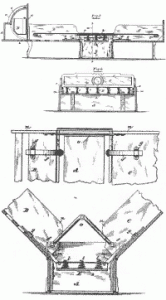
A desk that was fully functional with drawers and space to work that had a bed hidden in it.

You could do everything you wanted from storing paperclips to using the top of the desk to eat or do your taxes, and when you were ready for bed, you could open it and a full sized bed would unfold. There was a separate piece you could use to reinforce the middle of the bed.
source


 In the morning, you put the bed away and go on with the day.

Sarah patented the cabinet bed in 1885.

Sarah Goode died in 1905.


Things That Might Or Might Not Be True


The above facts seem to be mostly born out by all of the various sites I looked at and read. Now, there were lots of other things I found that seem either made up or fanciful, and possibly embellished.

This site says definitively that Sarah Goode was born into slavery.
Considering the fact she could read and write, that is highly suspect.


I found out there was a potential other African American woman who'd gotten a patent the year before Sarah. Her name was Judy Reed. Nobody knows anything at all about Judy Reed other than she got a patent in 1884. She signed her name "X".

I am not certain why anybody thinks Judy Reed was black.


Whilst searching for some kind of visuals for this post, I found a very "not an African American woman" picture listed with Sarah Goode's accomplishments on multiple sites.

I tracked the picture down and it turns out it is from a site for a family who was chronicling their  history in Wyoming The woman's name just happened to be Sarah Goode, but there is no reason to believe she invented anything, and she is most certainly not the first or possibly the second African American woman to ever patent anything.

I was amused that so many people had reprinted the picture without questioning it.

In Conclusion

All of that said, I give you Sarah Goode. She created the first cabinet bed that could double as a piece of functional furniture.

Sarah's creation was the precursor of the Murphy Bed, the sofa bed, and all the hideaway beds we have today.

Thank you, Sarah!

Celebrate Black History!

Day 1 - The ABC's of Black History Month
Day 6 - Ernest Everett Just - Biologist, Zoologist, Cell man
Day 7 - Frederick McKinley Jones - The Coolest Man in Modern History
Day 8 - Sarah Goode - A Practical Bed For Small Spaces
Day 9 - William Henry Cling - Did He Invent The Hospital Bed Before Gatch?
Day 10 - Inez Beverly Prosser and Brown V.S. The Board of Education
Day 11 - Jan Ernst Mateliger - Mechanical Engineer/Sole Man
Day 12 - Samuel L. Kountz Jr. - Revolutionized Transplant Surgery
Day 13 - Lewis Howard Latimer - Incandescent Inventor
Day 14 - Marie Van Brittan Brown - Home Security
Day 15 - Norbert Rillieux - Sugar Man
Day 16 - Otis Boykin - He Kept Hearts Beating
Day 17 - Alice H. Parker - Heating It Up!
Day 18 - Lloyd Quarterman - Chemist and Atom Man
Day 19 - Robert F. Flemming Jr. - Guitar Man
Day 20 - Charles S. L. Baker - The Friction Radiator 
Day 21 - Granville T. Woods - The Black Edison
Day 22 - Alfred L. Cralle - Next Time You Have Ice Cream...
Day 23 - Ellen Elgin - Through The Wringer
Day 24 - Dr. Daniel Hale Williams - Holding A Heart In the Palm of His Hands
Day 25 - Benjamin Bradley - Steam Engine Dominance
Day 26 - Elijah McCoy - The Real One
Day 27 - Alexander Miles - Hold The Door, Please!

Thursday, February 7, 2019

Day - 7 Frederick McKinley Jones - The Coolest Man In Modern History

Frederick McKinley Jones


Frederick McKinley Jones - 1893 - 1961


A Rough Road


Right out of the shoot there is some disagreement about where Frederick was born. Most sources say it was Cincinnati, Ohio, but I found another that suggested it might have been Covington, KY.

Either way, he was orphaned at a very young age. His mother abandoned him, and by the age of seven, his father could not care for him and sent him to live with a Catholic priest in Kentucky. His father died a couple of years after that.

Frederick left school after the sixth grade and went back to Cincinnati. He made a living cleaning. At age fourteen he started working for an automobile repair shop.


A Self-Taught Mechanical Engineer


Frederick never went back to school. Everything he ever learned about engineering, mechanics, and machines he either came up with himself, learned from watching others around him, or by reading voraciously.


Jones let the winds of life blow him where they would as he sought to build a life for himself despite the difficulties in advancing in a job as an African American.

In 1912, Jones moved to Hallock, MN to work on a 50,000-acre farm as a mechanic. He served in WW I and returned to Minnesota when the war ended. He took another job as a mechanic.

That's when life got interesting.

He taught himself about electronics and built a transmitter for the town's new radio station.

Jones then built a device to combine sound with moving pictures. This invention attracted the attention of a fellow named Joseph A. Numero, who hired Jones to improve the sound equipment he sold at his company Cinema Supplies Inc.

Source
Then, in 1938, Jones did something that changed how the entire world works. He designed and patented a portable cooling unit for trucks.

Keeping It Cool


Before 1938, the only way people could transport perishable things from place to place was to pack as much ice in as possible, move as fast as possible, and pray. Long distance shipping was out of the question. 

The inspiration for this invention has several different versions of the same story. It may be an urban legend or it might be true.

Either Jones was speaking directly to a farmer who'd lost a shipment of chickens because the ice melted before he could get his meat to market, or it was a rich farmer talking about all the times he'd lost produce, or it was a farmer over a drink or a farmer on a golf course, or it was Numero's friends and Jones wasn't there at all...take your pick.

In any case, after hearing this story, Jones got the idea to try and create a truck that could keep things cold.

Jones portable colling unit upended how everything - and I am not being hyperbolic - everything that must remain cold could move from one place to another.

The US Thermo Control Company

In 1940, Joseph Numero sold his company with the improved sound equipment Jones had engineered to RCA. With that money, Numero and Jones formed a partnership and opened a company called The US Thermo Control Company.

You might recognize it by its current name: Thermo King.

Source


There is no way to stress how drastically Frederick McKinley Jones changed the world.

Jone's work had a huge impact on how we shipped and stored blood during WWII.  (Shout out to Charles Richard Drew)

It changed the way we shipped supplies and medicine during the war.

Today, portable refrigeration is a critical part of the world's infrastructure. 

Lauded and Acclaimed

Frederick McKinley Jones was widely recognized and acclaimed during his lifetime, and he actually saw a financial gain from his inventions during his lifetime.

Over the course of his long life of inventing, Jones was awarded 61 patents in the areas of refrigeration, portable x-ray machines, sound equipment, and gasoline engines.

In 1944 - Jones was the first African American to be elected into The American Society for Refrigeration Engineers. (I had no idea that was a thing)

In the 1950's he consulted with the Department of Defense and Bureau of Standards.

In 1961, he died of lung cancer.

In 1977 he was elected into the Minnesota Inventors Hall of Fame.

source


He was posthumously awarded the National Medal of Technology in 1991 - The first African American to ever receive that award.


So, the next time you buy some delicious but perishable seasonal fruit from halfway around the world, dine on a delicious piece of Kobe beef in America,  have to take medicine that says, "Keep Refrigerated" on the back of the bottle, or pass a refrigerated truck of any kind on the highway, say a thank you to Frederick McKinley Jones.

-Celebrate Black History Month


Day 1 - The ABC's of Black History Month
Day 6 - Ernest Everett Just - Biologist, Zoologist, Cell man
Day 7 - Frederick McKinley Jones - The Coolest Man in Modern History
Day 8 - Sarah Goode - A Practical Bed For Small Spaces
Day 9 - William Henry Cling - Did He Invent The Hospital Bed Before Gatch?
Day 10 - Inez Beverly Prosser and Brown V.S. The Board of Education
Day 11 - Jan Ernst Mateliger - Mechanical Engineer/Sole Man
Day 12 - Samuel L. Kountz Jr. - Revolutionized Transplant Surgery
Day 13 - Lewis Howard Latimer - Incandescent Inventor
Day 14 - Marie Van Brittan Brown - Home Security
Day 15 - Norbert Rillieux - Sugar Man
Day 16 - Otis Boykin - He Kept Hearts Beating
Day 17 - Alice H. Parker - Heating It Up!
Day 18 - Lloyd Quarterman - Chemist and Atom Man
Day 19 - Robert F. Flemming Jr. - Guitar Man
Day 20 - Charles S. L. Baker - The Friction Radiator 
Day 21 - Granville T. Woods - The Black Edison
Day 22 - Alfred L. Cralle - Next Time You Have Ice Cream...
Day 23 - Ellen Elgin - Through The Wringer
Day 24 - Dr. Daniel Hale Williams - Holding A Heart In the Palm of His Hands
Day 25 - Benjamin Bradley - Steam Engine Dominance
Day 26 - Elijah McCoy - The Real One
Day 27 - Alexander Miles - Hold The Door, Please!

Wednesday, February 6, 2019

Day 6 - Ernest Everett Just - Biologist, Zoologist, Cell Man

Source


Born 1883 - Died 1941

A Difficult Start


Ernest E. Just was born in South Carolina. His early life was fraught with difficulties.

When he was four years old, both his father and grandfather died, leaving his mother to raise him and his two siblings alone.

His mother, Mary Matthews Just, took a job teaching at the negro school in the area and spent the summer in the phosphate mines of South Carolina.

While working, she noticed that there was lots of empty land near the mines, and encouraged African Americans to set up homes there. It is believed that the town founded on the land is named for her - Maryville, SC


Kimball Union Academy
Education

Ernest was very bright, and his mother sent him to The Colored Normal Industrial Agricultural and Mechanical College of South Carolina. He did well there, but both Mary and Ernest thought that the education for black people in the south was inferior to what he could get in the north.

When he was sixteen, his mother shipped him to New Hampshire where he attended Kimball Union Academy.


He returned home for a visit after his second year to discover his mother had been buried one hour earlier. He returned to New Hampshire and threw himself into his studies, determined to make sure the trust his mother placed in him was not wasted.

He graduated from Kimball in three years instead of four in 1903 and was at the top of the class.


Just got his undergrad degree at Dartmouth College. He was magna cum laude, and he was even considered to give the commencement speech, but the faculty decided it would be a bit too uncomfortable for the parents and guests to find out that the only black student in the graduating class had won almost every single award and honor the college offered.

A Black Scientist In America

Ernest had the same problem every other black scientist had in the early 1900s. No matter how brilliant or capable, most universities had white faculties and white students, and they were not about to hire a black instructor.


He joined the faculty of Howard University.  Howard did not have sufficient labs or equipment to do the types of research Just wanted to undertake.

Shortly after joining Howard, Just met Frank R. Lillie who was in charge of the Zoology department at the University of Chicago and a director of the Marine Biological Laboratory in Woods Hole, MA.


Lillie invited Just to spend the summer at the lab in MA. Ernest took him up on it. In fact, he spent the next twenty summers - with one exception apparently - at the MBL.

In 1916, Just achieved a doctorate from the University of Chicago. By that time, he was already becoming famous for his published papers about cells and how their surfaces reacted with each other. He also wrote about the cell's place in evolution, egg fertilization, and how embryos formed.

He was considered a genius in the design of experiments...but no other university in America would hire him.

A Black Scientist In Europe


His work with cells was both brilliant and completely ignored for years in America. Europe was a different matter.

In 1929, he conducted experiments at Anton Dohrn in Naples, Italy.

In 1930 he became the first American to ever be invited to the Kaiser Wilhelm Institute.

Between 1929 and 1938, Just visited Europe ten times.

European scientists treated Just like a colleague, and the times he did run into racism abroad, it was usually from Americans traveling in Europe.

Contributions

Ernest Just wrote books, numerous papers, and articles about his observations and experiments on cells. His work is still considered brilliant, and it is the backbone of our modern understanding of cells.

source


Breeding Habits of the Heteroneteis Form of Nereis Limbata at Woods Hole/Mass by Frank R. Lillie and E. E. Just

"This work has been selected by scholars as being culturally important and is part of the knowledge base of civilization as we know it."


The Biology of the Cell Surface by Ernest Everet Just


Death

When World War II broke out, Just was at the Station Biologique de Roscoff. The French Government told all of the foreigners to leave but Just stayed to complete his research.

In 1940 the Nazis invaded and Just was put in a POW camp. In 1941 the American government negotiated for his release. He'd fallen ill during his imprisonment, and when he returned home he was diagnosed with pancreatic cancer. He died shortly thereafter.


Ernest Everett Just pioneered work on cells in his day, and his work is still informing modern day scientists.

There is lots more to learn about Ernest Everett Just.

In 1911 he co-founded the first black fraternity, Omega Psi Phi.
In 1996 the US postal system gave him his own stamp. 

There are lots of really long science words and terms and such that Just studied, but this is a thumbnail, not a dissertation.

Thank you, Ernest Just for all the knowledge you contributed to our modern understanding of cellular functions!


-Celebrate Black History Month!

Day 1 - The ABC's of Black History Month
Day 6 - Ernest Everett Just - Biologist, Zoologist, Cell man
Day 7 - Frederick McKinley Jones - The Coolest Man in Modern History
Day 8 - Sarah Goode - A Practical Bed For Small Spaces
Day 9 - William Henry Cling - Did He Invent The Hospital Bed Before Gatch?
Day 10 - Inez Beverly Prosser and Brown V.S. The Board of Education
Day 11 - Jan Ernst Mateliger - Mechanical Engineer/Sole Man
Day 12 - Samuel L. Kountz Jr. - Revolutionized Transplant Surgery
Day 13 - Lewis Howard Latimer - Incandescent Inventor
Day 14 - Marie Van Brittan Brown - Home Security
Day 15 - Norbert Rillieux - Sugar Man
Day 16 - Otis Boykin - He Kept Hearts Beating
Day 17 - Alice H. Parker - Heating It Up!
Day 18 - Lloyd Quarterman - Chemist and Atom Man
Day 19 - Robert F. Flemming Jr. - Guitar Man
Day 20 - Charles S. L. Baker - The Friction Radiator 
Day 21 - Granville T. Woods - The Black Edison
Day 22 - Alfred L. Cralle - Next Time You Have Ice Cream...
Day 23 - Ellen Elgin - Through The Wringer
Day 24 - Dr. Daniel Hale Williams - Holding A Heart In the Palm of His Hands
Day 25 - Benjamin Bradley - Steam Engine Dominance
Day 26 - Elijah McCoy - The Real One
Day 27 - Alexander Miles - Hold The Door, Please!

Tuesday, February 5, 2019

Day 5 - Mary Beatrice Davidson - Inventor of the Sanitary Pad

Mary Beatrice Davidson Kenner 1912 - 2006


Who was she?

Born in Monroe County, NC in 1912

Mary Davidson was born to invent things.  Her first attempt was to make a self-oiling door so that when her mother went out the back door in the morning the squeaking wouldn't wake her.

She was six.


Mary credits her father for encouraging her to explore things. She was bright and did well in school, but had to drop out of Howard after less than a year for lack of funds.

She never got an advanced degree.

Mary holds five patents. That is more than any other African American woman in history.


What did she invent?

Mary invented a number of things that improved the lives of women and people who needed extra assistance.

Her most famous invention was a sanitary belt attached to a pocket that was moisture proof. 

She invented the belt first and patented the moisture proof pocket later.

The Sanitary belt and tissue holder.
There were not very many options for women who were menstruating back in the day. They used wads of cloth or rags, and it wasn't advisable to leave the house. There were tampons, but it was considered scandalous to use them. Mary's invention addressed the problem.

She added a cloth pouch with a moistureproof seal that attached to the belt. You put rags or cotton into the pouch. It was the pocket for padding and the moisture proof seal that made it revolutionary. Mary Beatrice Davidson had invented the first generation of what would eventually be called the sanitary pad or napkin.

It meant you could actually go out in public without fear of getting blood everywhere.

When she first patented it, a company sent a representative down to speak to her. when they found out she was black, they lost interest. It was 30 years before anyone picked up the patent and started manufacturing them.

She also designed an improved bathroom tissue holder that allowed the dangling end of the tissue to be accessible at all times. 

When her sister Mildred - an inventor in her own right -  was diagnosed with Multiple Sclerosis, Mary invented and patented a tray and carrier that attaches to a walker.

Mary also invented a back washer that attaches to the wall for people who would find it hard to wash their backs any other way.


Inventing Because It Was Fun

Mary did not make money off of any of her inventions, but she never lost the joy of making things. 


She owned her own florist business in Washington DC until her death in 2006.

Thank you, Mary Beatrice Davidson Kenner for making "that time of the month" less burdensome for women.

Celebrate Black History!

Day 1 - The ABC's of Black History Month
Day 6 - Ernest Everett Just - Biologist, Zoologist, Cell man
Day 7 - Frederick McKinley Jones - The Coolest Man in Modern History
Day 8 - Sarah Goode - A Practical Bed For Small Spaces
Day 9 - William Henry Cling - Did He Invent The Hospital Bed Before Gatch?
Day 10 - Inez Beverly Prosser and Brown V.S. The Board of Education
Day 11 - Jan Ernst Mateliger - Mechanical Engineer/Sole Man
Day 12 - Samuel L. Kountz Jr. - Revolutionized Transplant Surgery
Day 13 - Lewis Howard Latimer - Incandescent Inventor
Day 14 - Marie Van Brittan Brown - Home Security
Day 15 - Norbert Rillieux - Sugar Man
Day 16 - Otis Boykin - He Kept Hearts Beating
Day 17 - Alice H. Parker - Heating It Up!
Day 18 - Lloyd Quarterman - Chemist and Atom Man
Day 19 - Robert F. Flemming Jr. - Guitar Man
Day 20 - Charles S. L. Baker - The Friction Radiator 
Day 21 - Granville T. Woods - The Black Edison
Day 22 - Alfred L. Cralle - Next Time You Have Ice Cream...
Day 23 - Ellen Elgin - Through The Wringer
Day 24 - Dr. Daniel Hale Williams - Holding A Heart In the Palm of His Hands
Day 25 - Benjamin Bradley - Steam Engine Dominance
Day 26 - Elijah McCoy - The Real One
Day 27 - Alexander Miles - Hold The Door, Please!

Monday, February 4, 2019

Day 4 - Charles Richard Drew - Blood Man

Charles Richard Drew 1904 - 1950


The mister has been giving blood since he was in his twenties. These days he gives platelets.

He donates at least twice a month. Sometimes, if the Red Cross is having a shortage of his blood type they call him and he makes a special trip.

Most people probably do not think twice about how we bank blood, or who developed the procedures for collecting and storing blood products. Luckily, right around World War II, people were thinking about this pretty intensely.

Charles Richard Drew was born in Washington, DC in 1950 to a middle-class African American family. His father was a carpet layer, and his mother was trained as a teacher.

He was not a brilliant student when he was young, but he was an excellent athlete.

In 1922, Drew earned an athletic scholarship to Amherst College in Massachusetts. He was one of 13 African Americans in a school of 300. In his senior year, he was passed over for captain of the football team even though he was the best player.

As far as academics? He had no idea what he wanted to do until he took a biology class. It changed the entire course of his life. He decided to study medicine.

Unfortunately, there were very limited opportunities for black people interested in any science. Many of the programs in America wouldn't consider accepting a black student into their programs. His path to becoming a doctor was very narrow.

He did his graduate work at McGill University College of Medicine in Montreal, Canada. While he was at McGill, he won lots of prestigious awards, scholarships, and was on the staff of The McGill Medical Journal.

In 1933, Drew graduated second in his class of 137 earning his MD and CM (Mastery of Surgery) Degrees.

From 1933 - 1935 Drew did his surgical internship at Montreal Hospital. It was at this time that he became interested in transfusions and working with blood products.

Freedmen's Hospital
He wanted to study at the Mayo Clinic, but black doctors were banned from practicing there. Mayo's loss was Howard University's gain.

He joined the faculty at Howard, and taught classes as well as interning at Freedmen's Hospital.  He worked his way up to Chief Surgical Resident.

In 1938, Drew studied at Columbia University for his doctorate. He won a fellowship to got to New York and study with the eminent surgeon,  Allen Whipple at Presbyterian Hospital in New York.

When Charles Drew arrived, instead of giving him the duties he was supposed to have working in labs and seeing patients, Whipple assigned Drew to a grant project that was being run by John Scudder to set up an experimental blood bank. This way none of the white patients or lab technicians had to either work with, be supervised by, or encounter Drew.

John Scudder was not unhappy to have him,

"Scudder considered his protÉgÉ “naturally great” and a “brilliant pupil” and Whipple would later be won over by Drew’s talent, supporting both his surgical training and doctoral research. Drew and Scudder focused their research on diagnosing and controlling shock, fluid balance, blood chemistry, preservation, and transfusion — the work on which he based his seminal dissertation, "Banked Blood: A Study in Blood Preservation." Scudder remarked that the thesis was “a masterpiece” and “one of the most distinguished essays ever written, both in form and content.”

Drew married Minnie Lenore Robbins in 1939. Minnie was a professor of home economics at Spelman College.

In 1942, Charles Drew earned a Doctor of Science in Medicine from Columbia University. He was the first African American to have done so.

Scudder recruited Drew to help him set up a blood bank in England in WWII for the war effort.

The process Drew, Scudder, and E. H. L. Corwin created to store and ship blood products safely is the model we use today.

Drew went back to Howard and worked hard to train black physicians. His dream was to create the most excellent physicians anywhere in the country.

He also worked with the Red Cross to establish blood banks around the country.

Source
Charles Drew was the person who came up with the idea of a "bloodmobile" and the necessary equipment needed to safely store and transport the collected blood to blood banks.

Despite Drew being the pioneer of the way the Red Cross collects and stores blood, the organization did not accept blood from African Americans.

Drew wasn't able to donate. He railed against this restriction as nonsensical and unscientific. He said it was insulting to African Americans who were just as eager to help the war effort as any other Americans.

The Red Cross did eventually start allowing blacks to donate, but they kept their blood segregated.


There are some stories that Charles Drew resigned his position as Assistant Director of the National Blood Donor program and returned to teach full time at Howard because he was so disgusted by the Red Cross's policies about how they handled African American blood donations.

There are also those who claim he had always planned to go back to Howard to teach and that he had been too long away from his wife and their first child, BeBe whose name is really the initials for Blood Bank.

In 1950 he was off to a conference after having been in surgery the night before and fell asleep at the wheel. The car went off the road and into a field where it cartwheeled several times.

The other people in the car had minor injuries, but Drew's foot got caught beneath the brake pedal, and his leg was horribly mangled.

Despite rushing him to a hospital and getting all the treatment possible, Charles Drew died of his wounds.

There are stories in the cultural fabric of this country that Drew died because he was denied a transfusion that would have saved his life, but that is just urban legend.

The Drew Family
His legacy of commitment to creating strong, knowledgable healthcare professionals lives on in a small private University in California. In 1966, as a way to combat poor access to healthcare for African Americans and as part of the Civil Rights movement to promote equality, The Charles R. Drew University of Medicine and Science was established.

The next time you hear about a blood drive, or give any blood products, or drive by a Red Cross, you are looking at the enduring legacy of one of America's Genius African American Physicians.

There is so much I left out of this quick sketch about how incredible and brilliant this man was. Follow some of the links and they will lead you to other links.

I'm a history nerd. I've been down this rabbit hole for the last two days and I've only surfaced to write down a few notes!

Lastly, I love it when my worlds collide.

In February of 2018, Minnie Lenore Robbins Drew's grandson interviewed his mother about his grandmother on StoryCorps. The interview is 12 minutes long. Have a listen!

Thank you, Dr. Charles Richard Drew for all that you gave us.

Celebrate African American History Month!

Day 1 - The ABC's of Black History Month
Day 6 - Ernest Everett Just - Biologist, Zoologist, Cell man
Day 7 - Frederick McKinley Jones - The Coolest Man in Modern History
Day 8 - Sarah Goode - A Practical Bed For Small Spaces
Day 9 - William Henry Cling - Did He Invent The Hospital Bed Before Gatch?
Day 10 - Inez Beverly Prosser and Brown V.S. The Board of Education
Day 11 - Jan Ernst Mateliger - Mechanical Engineer/Sole Man
Day 12 - Samuel L. Kountz Jr. - Revolutionized Transplant Surgery
Day 13 - Lewis Howard Latimer - Incandescent Inventor
Day 14 - Marie Van Brittan Brown - Home Security
Day 15 - Norbert Rillieux - Sugar Man
Day 16 - Otis Boykin - He Kept Hearts Beating
Day 17 - Alice H. Parker - Heating It Up!
Day 18 - Lloyd Quarterman - Chemist and Atom Man
Day 19 - Robert F. Flemming Jr. - Guitar Man
Day 20 - Charles S. L. Baker - The Friction Radiator 
Day 21 - Granville T. Woods - The Black Edison
Day 22 - Alfred L. Cralle - Next Time You Have Ice Cream...
Day 23 - Ellen Elgin - Through The Wringer
Day 24 - Dr. Daniel Hale Williams - Holding A Heart In the Palm of His Hands
Day 26 - Elijah McCoy - The Real One
Day 27 - Alexander Miles - Hold The Door, Please!

Sunday, February 3, 2019

Day 3 - Sarah Boone 1832 - 1904 - Inventor and Dress Maker


Sarah Marshall Boone 1832 - 1904
Sarah Marshall was born in 1832 in Craven County North Carolina near New Bern.

She married freedman James Boone in 1847 when she was 15.

Prior to the start of the Civil War, the couple moved to New Haven, Connecticut where they lived the rest of their lives.


Sarah worked as a dressmaker. She spent lots of time making, prepping, and showing her work. She also spent lots of time fitting dresses on clients.

One thing that is true of dressmakers is that they have to do lots of ironing. Sarah was no different.

Add caption


Ironing has been going on for as long as people have demanded their garments be wrinkle free. The oldest known examples of this come from....the Vikings. Yes, apparently you should be well turned out before you sack and burn.

Viking ironing boards were made of whalebone, and they used heated rocks or glass to smooth their fabric.


I could not find any information about how the craze of ironing spread throughout Europe, but I suspect it was the success the Vikings had at invading surrounding non-Viking cultures and infusing them with their own people and customs.


a really old iron


In any case, the newly wrinkle free Europeans needed something other than whalebone because there were way too many people ironing. This led to using whatever table they had handy. The process was simple.


You heat up a piece of iron, put some kind of cloth over your table so you don't ruin the wood, put whatever you mean to make wrinkle-free on top of the cloth, and make it happen.

Not every woman ironed on her table. Some of them got the idea to get a board and balance it between two chairs. They would then put some kind of cloth on the board, put the thing they wish to make wrinkle-free on top of the cloth and make it happen.
Woman ironing with board on chairs


By the 19th century, ironing had not only been exported to the Americas, but there was apparently lots of advice about the best type of cloth to put on your board or ironing table in order to get the smoothest look.


The best choice? Swanskin.


Swanskin

I was pretty mortified until I did some more reading and discovered that they weren't suggesting that women should go down to their local pond and skin the swans. No, apparently there is a fabric called Swanskin.

Some enterprising company started manufacturing this stuff for the stated purpose of covering your board or table. It was dyed bright red.

The manufacturers of the time tried to convince women not to use their red cloaks...which apparently was a thing, to cover their boards or tables, assuring them that was a low-class move. They HAD to have the red swanskin covering.

Hard selling women on nonsense since the beginning.


As you can imagine there were now Better Homes and Gardens types of columns and magazines marketed to women, and ironing was discussed on a regular basis. There were varying opinions of what sort of board to use, how long it should be, what you should cover it with, and the best way to get that wrinkle-free look.

Now that women were being told that they had to get a specific type of fabric and board on which to iron, the invention of an object that was specifically for ironing couldn't be far away, and it wasn't.

In 1858 a fellow by the name of W. Vanderberg took out a patent for an "ironing table".

Somewhere around 1861 another dude, Isaac Ronnie Bord of Georgetown, Deleware took out a patent for "an adjustable flat horizon surface that could be used for the pressing of garments, undergarments and bed linens".

This is where Sarah Boone, dressmaker, enters the story.

Sarah realized that the designs of all of the objects available to her were sort of useless in terms of making the activity more efficient. At which point, she designed her own ironing board.


Sarah Boone's Ironing Board


Then, she patented it.

In her application, she wrote that "the purpose of her invention was “to produce a cheap, simple, convenient and highly effective device, particularly adapted to be used in ironing the sleeves and bodies of ladies’ garments.”


Her board was specifically created to make sure that the sleeves could be ironed without any creases.

Sarah Boone was one of three black women in her day who created inventions for the home. Her designs influenced the current ironing boards we have today.

Every single time you open up your handy dandy, easily stored ironing board before that big meeting, or whatever has made you decide you need to look a bit more spiffy, you have Sarah Boone to thank.

For all of you out there who hate ironing...at least you don't have to go run down red swanskin, and it isn't necessary to buy a huge piece of immovable furniture that is dedicated to nothing else aside from "pressing" your garments, undergarments and bed linens.

Thank you, Sarah Boone, for helping us to stay wrinkle-free.

Celebrate Black History Month!

Day 1 - The ABC's of Black History Month
Day 6 - Ernest Everett Just - Biologist, Zoologist, Cell man
Day 7 - Frederick McKinley Jones - The Coolest Man in Modern History
Day 8 - Sarah Goode - A Practical Bed For Small Spaces
Day 9 - William Henry Cling - Did He Invent The Hospital Bed Before Gatch?
Day 10 - Inez Beverly Prosser and Brown V.S. The Board of Education
Day 11 - Jan Ernst Mateliger - Mechanical Engineer/Sole Man
Day 12 - Samuel L. Kountz Jr. - Revolutionized Transplant Surgery
Day 13 - Lewis Howard Latimer - Incandescent Inventor
Day 14 - Marie Van Brittan Brown - Home Security
Day 15 - Norbert Rillieux - Sugar Man
Day 16 - Otis Boykin - He Kept Hearts Beating
Day 17 - Alice H. Parker - Heating It Up!
Day 18 - Lloyd Quarterman - Chemist and Atom Man
Day 19 - Robert F. Flemming Jr. - Guitar Man
Day 20 - Charles S. L. Baker - The Friction Radiator 
Day 21 - Granville T. Woods - The Black Edison
Day 22 - Alfred L. Cralle - Next Time You Have Ice Cream...
Day 23 - Ellen Elgin - Through The Wringer
Day 24 - Dr. Daniel Hale Williams - Holding A Heart In the Palm of His Hands
Day 25 - Benjamin Bradley - Steam Engine Dominance
Day 26 - Elijah McCoy - The Real One
Day 27 - Alexander Miles - Hold The Door, Please!