Friday, August 26, 2016

The Language Of Poverty: Reframing That Story

I remember one of my first teaching experiences when I was a young teaching artist in Chicago. I was in a school in an impoverished neighborhood. In one of my classes, a kid lost a dollar bill. I made an announcement that if anyone found it, it belonged to this child.

Not five minutes later, a child found the dollar bill and announced he'd found it, and was going to keep it. I pointed out that we knew who it belonged to and he should give it back. He refused.

I asked, "If you'd lost a dollar, and someone found it, wouldn't you want them to give it back to you?"

"Yes," he replied.

"Then return the dollar to her." 

"No."

I don't remember how that ended. I believe the teacher got involved and it was a mess. 

I taught in several impoverished schools that year. I realized something.

I was not an appropriate teaching artist for this population. I didn't understand these children. I didn't know how to reach them. I didn't know what I should be trying to achieve. My lack of understanding inhibited my efficacy in their learning environment.

I understood that a different approach was needed, but I had no idea what that should have been, or how to make that happen. My concern was that I could be doing damage. I certainly felt that I was, and there was a teacher who let me know in no uncertain terms that she thought I was.

That was twenty-eight years ago.

I perform in schools in impoverished areas all the time. I do workshops with kids in those schools, but I haven't taught any residencies in them.

I am a huge believer in literacy strategies and language acquisition tools in the classroom and at home. I am a huge believer that almost any child can be reached, it just requires the right keys, and I don't often know what those are.

This morning, as I went through my daily news input before getting down to work everything stood still.


My brain, as it often does, went a bit nuts after ingesting this information.

Disclosure: The article is long but worth the read.

The Findings? People who are exposed to long-term violence, privation, malnutrition, toxic pollution, danger, and or abuse from childhood have less developed brains. They have poorer problem-solving skills,  less empathy, more impulse control issues, and a whole host of other cognitive processes that make functioning in our society difficult. 

The story that unfolds is more about how this one girl manages to overcome the neighborhood and the violence and fear that surrounded her to head off to college.

The key seems to have been her parents working hard to make sure that despite everything around them, they kept their girls as safe as they could, and away from the world on the other side of their walls, and a single teacher who encouraged and supported her.

In her discussions about her life, the words 'safe' and 'warm' came up over and over again. She had places where she was okay, and she could still the fear. Those islands gave her a chance for a better life.

One of the points the article makes is that it isn't enough to work with the children of poverty, we must also work with their parents.

One of the takeaways was a fear that certain demographics in our country would be demonized because of this study, and a new Eugenics push could be spawned.

The biggest point the article makes is that we need to fundamentally rethink how we educate, interact with, and help people who live in poverty.

The private infrastructure we have now is not so much about helping people in poverty as it is about taking advantage of some of the problems, and pointing in confusion at others all while saying 'We Need To Do Something!' without having a clear idea of what we should do.

For Profit Prisons
Debtors Prison
Prisons and Poverty
Day to Day Expenses
Education

The public funded elements of helping people in poverty are sometimes fueled by misinformation, ideological disagreements, and outright harmful decisions. Our government often tries to balance its budget on the backs of the poor and disenfranchised.

Drug Testing Welfare Recipients
Cutting School Lunch Programs
Government and the Poor


Our country and the world at large are fraught with situations of our own creation that ensure a segment of our population is going to struggle to find a productive place in our civilization.

Homelessness - Link to a post I did about telling in an affluent school and then one that serves homeless children in the same week telling the same stories.


So, I looked at the article. I considered all of the things I've read in the past, and the work I've done with so many children and it leaves me still.

I am fighting the despair.
I am fighting the anger.
I am fighting the frustration.

I am trying to be empty of these things so I can think. I am waiting for there to be clarity so I know how to go forward productively and without bitterness for what we do to each other every day, and what I must continue to try to do on whatever small scale I can.

I can't solve this problem by myself.
Nobody can solve this problem alone.
This work we must do together.

The realities are daunting.

The answers will be financially painful for some, and they will fight tooth and nail with very deep pockets to keep this system in place.

The answers will be uncomfortable for some, and they will deny them for everything they are worth loudly and with giant megaphones.

The answers will require a profound rethinking of how we educate our children, and that will require a revamping of everything from grad school to how we train our educators, and there will be those who claim it won't matter.

We have so much work to do.

Do we as a creature have the will to do it?

I don't know, but there are things of which I am sure.

This is why politics matters.

This is why how we fund schools matters.

This is why what we teach our children matters.

This is why we must show our children positive images.

This is why we must continue to tell stories...even the hard ones.

This is why I am trying to be still this morning. This is why I am trying to be empty.

Happy Taking It One Story At A Time.


Thursday, August 18, 2016

Everyone Has Special Needs: Laying the Groundwork for a Successful Encounter

When I do public shows, I tell the audience what my plan is before I perform. 

I do this for several reasons. 

1) Many of the people in the room may have never encountered a storyteller, and this gives them some idea of what is about to happen.

2) There are always children who are hungry, antsy, upset (for whatever reason) or just plain bored before it begins. This gives everyone a chance to know how long they have to sit, and what will be required of them.

3) Sometimes I ask what kind of stories they want. Do they want me to sneak in a kind of scary story? Should we do something really silly? I adjust on the fly as I get feedback.

4) This creates a very important bond with the audience. I'm asking their permission to let me conduct a tour through the imagination, engage in conversation with talking animals, suspend their belief as I turn into various objects, emit wild noises, and generally remake the space they are in with nothing more than my voice, face and body. There is a certain amount of trust I need!  


5) Last, and most important, it gets the very diverse group of people in front of me used to seeing a woman with dreadlocks, dressed in what is often a voluminous non-mainstreamed looking outfit, moving and speaking in a stylized way, all while using grammar, inflection, diction, and language that may or may not be familiar to them.


I never do reveals. I like people to get a chance to encounter me before they have to engage in telling with me. I discovered early in my career that if I do reveals, the audience might need time to get used to me before they can listen to me, and I can lose up to fifteen minutes while they try to decide who or what I am.

I've found over the years, that every single audience has special needs. I have to meet them wherever they are.


Figuring out how to do that is the trick.

The needs are varied. They include people who need sign language interpreters, participants who cannot see, adults and older teens who present as children, or children with a wide variety of  behaviors, abilities, and responses that might be distracting...and toddlers...yes, for me toddlers and children younger than two years are the most special audience members.

Sometimes I am successful at reaching these audience members, and sometimes I am not.

Before I ever begin, I've learned that it is important for me to ask organizers if they know if there are going to be members in the audience who have needs that will be unique to them.

You might ask, 'Why are you singling them out? Why does it matter?'

It matters because the adjustments I can make will not diminish the experience for anyone else, but they might very well help these participants enjoy the stories.

Some of the adaptations I make are as follows.

1 - Be aware of jump moments and loud sounds. (I love loud sounds in stories, but not everyone does. Jumps are fun, but only if you have good recovery.)

2 - Pacing is very important. Make sure that you are allowing the participants to experience the tale at its fullest based on their needs for processing time. Tell the interpreter what you are planning to do. 


3 - Depending on your audience, adjust the amount of detail, movement, sound, or asides you offer. 


You never know who is going to be in your audience, or how they are going to react to you.


In March of 2014 I was in Fredericton, Canada. I had a show at a playhouse. Afterwards, I sold books and CDs, answered questions, and took pictures with kids...and grown ups!

There was one adorable little girl wearing something my daughter would have left the house in when she was little. She took a picture with me, and she and her mom left. Afterwards, I got a link to a blog post her mom wrote about what had gone on the morning of the show.


At the Fredericton Play House


I was humbled. It made me think of all the reasons why I do this work. It makes me consider how much work there is left to do. It made me consider my abject failures and those small triumphs someone shares with me.

I go into this new performance year...it starts in September...promising to do my best to be there for anybody who needs stories. I promise to be as patient as I can. I promise to challenge myself, and the audiences I encounter, to go as deep as we will, and share as openly as we must.

I promise to do my best to learn whatever it is people are trying to teach me.

I believe that sharing stories is the first step on the path to understanding each other...even when those stories are hard.

To all of my fellow artists - Good Luck in the 2016 - 2017 touring season!

To all of my fellow travelers on the raising children roller coaster - Good Luck and don't kill and eat them. That's illegal.


Son is in his 2nd year at RIT my daughter is at NCSSM


To all of my fellow educators, let's get with the knowledge enabling!

To all of my fellow humans who are going to be making the circuit around the sun for the next 365 days, let's see to it that as many of us arrive safely on the other side of this year as possible!


Let The New Performance Year Begin!

(Bangs the Gong)

Happy Learning!


Tuesday, August 9, 2016

The Power of Words: Reaching the Reluctant Reader

Photo Credit Jonathan Van Ark


I am not a reluctant reader. I have never been a reluctant reader. My insatiable desire to be wrapped in the printed word started when I was about four years old, and it has never abated.

For my bibliophilic brethren and sisteren, this sentiment is neither odd nor novel. Of course books are our life's blood! Of course we can think of few things better than curling up with a stack of beloved tomes, or a new series, and shutting out the mundane for a few days as we page our way through entire worlds of knowledge or entertainment.

As a young person, I did not understand anyone who did not share this love. How could anybody not love books? How could anyone not love reading?


Well, many years, and lots of life later, I understand that lots of people do not love reading. There are many reasons why they might not like it...or might think they do not like it, but that is neither here nor there. The question for educators and parents is about improving a student's motivation to read.

The approach that makes the most sense to me is outlined in a book called I Read, But I Don't Get It by Cris Tovani.  Simply put, people who read well and effectively read strategically. This process comes naturally to some, but not others. For reluctant or struggling readers, they must learn how to read strategically one step at a time. Unfortunately, we don't teach this process in school. If you don't intuit it, you are out of luck. (Since writing this piece, I have been told that there are places in the country where teachers are tackling the process of reading. I hope this becomes a movement!)

So. What does a 'good' reader do?

- Relate the text back to their own experiences
- Look for clues or subtext in the words and images
- Consider the outcomes of the events as they unfold
- Consider what they think might happen
- Come up with what they might have done if they had written the story.
- Restate ideas and concepts in their own words or thoughts
- Approach text with specific goals in mind
- Consider the way the author uses words and context to develop ideas or evoke images
- Follow characters as they develop
- Connect with the text on multiple levels

Question 1: How on earth do you teach all of that?
Question 2: How do you get someone who doesn't want to read in the first place to do any of that?


A friend of mine, Mark Spring, works with an organization here in Durham, NC called Student U. They just had their culminating reading project in the summer middle school program. This is what they did.

The sixth grade students were assigned the book The Outsiders.
There were four classes of sixth graders.
Each class was only assigned one fourth of the book.

Only having to read 1/4 of the book made many of these kids cheer. They wouldn't have to read the whole 'boring' thing.

Each class got a roll of butcher paper.


Every single page of their quarter of the book was printed and glued down to the top half of their roll. This left lots of blank space.

The students made notes around the pages about vocabulary they didn't know, defining the words in bright markers.

They looked at events on each page, and made comments about how those events related back to things they had heard about or experienced.

They shared ideas and hopes and wishes in that empty space. Ideas about their own lives as well as the story unfolding before them.

They made predictions about what they thought would happen. They recounted times when they had the same kinds of feelings as the characters. They gave advice to the characters.

They drew pictures that represented ideas or feelings.

They made predictions about what would happen if the characters made certain choices.

The space around the pages filled with the work of the readers.

At the end of the summer session, all four classes gathered. They taped their sheets together and each class got to see what the other classes had done.

I was invited to the Scroll Event where the sixth grade unfurled their scroll. I walked the entire book, page by page, and saw how the kids had chosen to tackle their quarters.

Sixth graders are funny. They were complaining about how hot it was, how much their arms hurt from holding up this long sheet of paper, and any other thing kids complain about, but any time I asked about the section they were holding, they would snap right out of complaining mode, and start telling me about what they'd contributed.

These kids were extremely proud of the work they'd done. I heard about their budding political beliefs, their particular thoughts about the Duke Health Systems, the words they'd defined, and how they felt about the characters.

When the scrolls were finally together, what lay before us was a page by page graphic of the amount of work your brain does when you are deeply reading a piece of fiction. It was fascinating.  Then came the kicker.

Mark asked, "How many of you read the whole book?"

Almost all of the kids raised their hands.

Despite only being responsible for 1/4 of the book, and not having time in class to read, most of them read the whole book on their own at some point this last summer.


They couldn't resist the lure. They got seduced into reading by reading. It was a beautiful thing.

There is joy in reading. I am glad these kids got to feel it. Now, if you'll excuse me...Mary Stewart is calling.


Happy Reading.

Wednesday, July 20, 2016

Hiatus


Zathura


Brain on overload!

Too much going on!

Too much input!

May Day! May Day!

All systems going haywire!

Shutting down for two weeks!

(Recalculating)

(Recalculating)

Friday, July 8, 2016

White For A Black Girl: A Short Observation About Skin Color

My son is nineteen. He does not drive.


....The first time my blackness was challenged was by black children in Beaumont, Tx. I went to school with lots of military children. They were every hue, and from every corner of the world. We didn't know the world we were part of was not usual. The black children in my grandmother's neighborhood told me that I 'talked proper' like a white person. I had absolutely no idea what they were talking about in those days. All I understood was that I was 'outside' and somehow different, but I didn't know how.

My son is nineteen. He does not drive.


....I spent my elementary school years in South Korea. In middle school we moved back to the USA. The white kids told me I wasn't like 'most black people' when I was at Eisenhower Middle school in Oklahoma. The black kids ignored, stayed away, or teased me, so I guess the black kids felt the same way. What do you do if everyone tells you that you are not who you are?


My son is nineteen. He does not drive.


....At Northwestern University I had people tell me they didn't 'think of me as a black person', or that when they saw me they didn't 'see color'. This was supposed to be a compliment. You see, they didn't hold my color against me. I wanted to shout, "Why do you have to pretend I am not black in order to accept me?" If I had ever said that out loud I am sure I would have offended the very well meaning people who make these statements, but perhaps I would have made them stop and think. By the time I got to college, I just wrote people off who said things like this. If you can't accept me as I am, then you aren't worth my time.

My son is nineteen. He does not drive.

...I did some wordless picture books with African American stories. The company who did the recordings had their staff come in and listen to the stories. One of the women was very upset. She raised her hand and asked, "Why didn't you get a black woman to record these stories?"

My son is nineteen. He does not drive.

So, what is the story here? What does it mean that I am not black? Well apparently it means that...

Black people do not speak clearly
Black people do not use proper grammar
Black people have a very specific voice
Black people do not write clearly
Black people are not polite
Black people do not take honors or AP classes
Black people do not read well
Black people do not write well
Black people do not have friends who are not black
Black people are not kind
Black people are not smart
Black people are not capable
Black people don't go to the top universities in the country
Black people are not lots of perfectly reasonable civilized things.

Apparently, if black people rise to some higher level, they graduate from blackness, and become honorary white people, or their color doesn't matter. It is a way of saying, "I met a black person who doesn't meet the stereotypes that I carry around in my head about black people, so he/she doesn't count."

My son is nineteen. He does not drive.

...My daughter is sixteen. She is at Governor's School West for theatre in North Carolina. On Wednesday, the mister and I went up to Winston Salem to see this show the drama group wrote. It was 30 plays in sixty minutes. The students wrote the plays. My daughter was in one called, White for a Black Girl. There were three black girls and each did a short monologue about what it is like to be a smart, accomplished black girl, and to be told that you were, in fact, white. The term now is, "You are the whitest black girl I have ever seen." or "You are a white black girl." Each piece ended with, "Is this what you want to see?" A white girl would step up behind them with white paint on her hands and put white hand prints on their faces before moving on to the next girl. The audience was quiet, uncomfortable, a little freaked out in their seats. I wondered, as I sat there, how many of the very white folks sitting around me had ever said that to a black person thinking they were paying them a compliment.


My son is nineteen. He does not drive.

I could start listing the names of the young black men who have been murdered by police in the last four years. I could call out their names and howl into the wind. I could tell about the morning George Zimmerman strutted out of his trial after having murdered a young black man, and how I lay in my bed that next morning sick with worry about the young black man who sleeps across the hall from my room. I could scream to the heavens about the executions of the two black men this week. I could demand justice. I could shout into the teeth of a screaming wind, "Black Lives Matter!" and I know that I will be met with anger from those who yell, "All Lives Matter" or "Blue Lives Matter!"
The problem isn't that all lives matter. The problem is that we have a story about those lives. The stories we tell are very different.

-Trayvon Martin is killed. The media shows him looking like what the media has decided a 'thug' looks like.


- Brock Turner rapes a woman. The media shows images of him in a suit looking clean cut and like the 'kid next door'.


So, What's the story here? What does it mean to be a black man in our society?

-Black men are inherently dangerous
-Black men are criminals
-Black men are violent
-Black men are unpredictable
-Black men need to be restrained
-Black men are scary
-Black men deserve to be treated like unstable animals


My son is a good student at Rochester Institute of Technology
My son is a sculptor
My son is a writer
My son is so kind
My son is a conscientious objector
My son is gentle
My son plays piano
My son likes to play Dungeons and Dragons
My son plans a career in 3D modeling
My son is really, really smart
My son loves Cosplay
My son is creative
My son is imaginative
My son would do anything for his friends
My son is a magic bean buyer.
My son is black.


If my son gets pulled over in a car for whatever reason, what will the police officer who pulls him over see?

My son is nineteen. He does not drive.


I've never really pushed him to learn. Truth is, I'm terrified.


I live for a day when people don't have to pretend accomplished black people aren't black in order to understand or accept them.


Tell Your Story

Wednesday, June 22, 2016

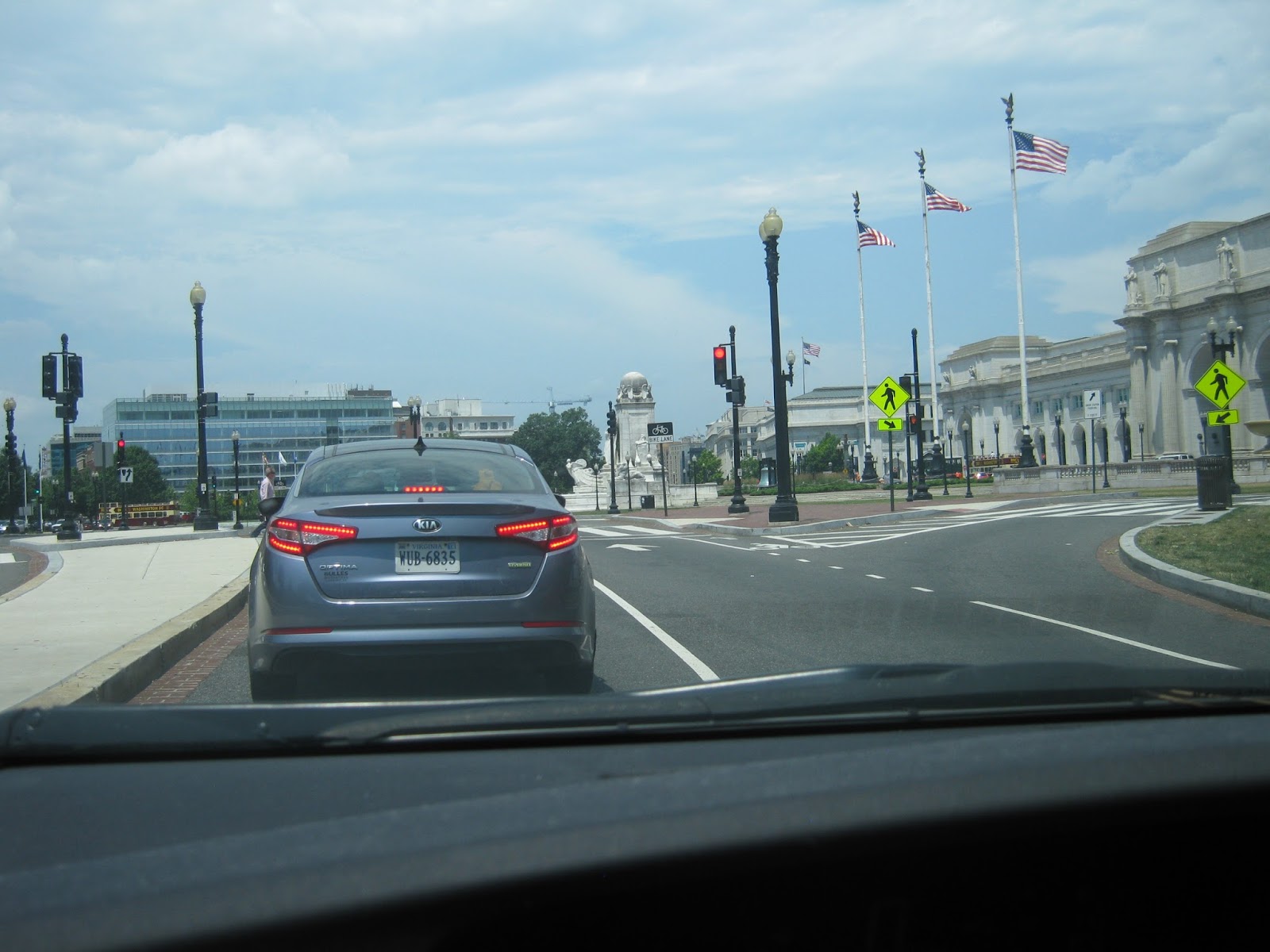
Was Satan Ever A Civil Engineer? The Perplexing Traffic In Washington DC


Our nation's capitol is a very interesting place. There are gorgeous buildings, food from every conceivable corner of the world, a rainbow of people, cultures, languages, neighborhoods and libraries.


You can go two blocks and move from a very nice area to a run down area. You could live in a tenement, or a restored Victorian less than a mile apart. In that respect it is like most cities.

The other thing you will find are the most confusing streets ever conceived by a hominid.

This leaves me with a question that has never been properly answered to my satisfaction:
(The Baby Pierre)

Q: Who the heck is responsible for this fuster-cluck?

A) A Baby?

B) Satan and a gleeful gaggle of sadistic demons?

C) Someone with a really twisted sense of humor?

D) Congress?

E) Someone who wanted make sure that if anyone ever invaded our capitol they would be lost in the first few minutes, unable to figure out how to turn around, confused about how to get out of the turn arounds, unable to figure out which streets were only one way when, caught in the numerous areas where six or seven lanes just collapse into two or three over the course of five hundred feet, and decide that since they'd only been moving at a max of three miles an hour anyway, and it had taken them forty five minutes to go about a mile and a half, they might as well just give up and find a nice place to get a smoothie, take some pictures, and visit a museum.

F) All Of The Above
Union Station! How come I can never find this place when I'm looking for it?

The night before my show at the Capitol View Library in DC on Tuesday, I google mapped three different routes. The plan was simple: Which of these routes would land me at my destination in the shortest amount of time with the least amount of traffic at 9:15am?

After scoping it out, I decided that rather than going through the middle of the city...suicide...or going around the west side of the city and over the Eisenhower Bridge...close to suicide..and then back through the city on 295...parking lot, I'd try the longest route which was going up the east side, cutting over on rte 6, and taking the longest loop of road.

ETA 55 minutes to go about fourteen miles.

No problem.

Best Laid Plans...

Five miles down 495 I realized something was wrong. Then, in my rear view mirror I saw the ambulance with its flashing lights picking its way through the cars that were going about ten miles an hour.

I made the executive decision to bail. But that was all right, I still had almost forty five minutes to get to my gig. 495/95 was too far west, so I hopped on 395 going past the Pentagon. The first five minutes I drove right on through clear and easy, and my hopes were high. Then, I got to the first merge. Yup, two lanes merge in from the right and then collapse down while one lane exits on the right to be replaced by two lanes on the left which also collapse. This is called, for want of a more technical term, foolishness.

Luckily, after all of the creeping and apologizing to people silently as I cut in and out of almost stopped traffic, I managed to get off of 295 with ten minutes to burn about one and a half miles from the library.

It took me fifteen minutes to go one mile and a half. I was five minutes late.

I left at 9:15am for a 10:30am show and I was five minutes late.

Luckily, that was all right. Part of the audience was still filing in when I arrived. It was a day care with fifteen children two years old or younger. At least they could all walk.

photo credit
My youngest audience member was eighteen months old. My oldest child audience member was eleven. We all had a great time. Didn't tell even one of the folktales they'd advertised I was going to tell. None of them would have been able to hold a two year old. I broke out the crazy. I even got adults, who didn't realize they were going to be called upon to take part, to participate with the kids. Johnny and Suzy Thumb was received enthusiastically by all.

Afterwards, I had a great discussion with a fellow who had grown up in the area and had some interesting observations about the black community. We spoke for almost half an hour.

It Pays To Find Out About Your Kid's Interests
His catch phrase is "He's One Hell of a Butler"
P.S. He's a demon
Got to my second show about an hour and a half before it began at 2pm. It was only five miles away from the first library. Actually, it was almost a straight shot...if DC actually had any roads that could be called a 'straight shot'.

This show was much smaller. Only six kids. When I asked if the kids liked to read, the twelve year old boy did not raise his hand.

"You don't like to read?" I asked.
"Well." He said a bit shamefacedly, "Just comics."
"That's reading!" I exclaimed. "If you like to read comics then you do like to read."

Attack On Titan
He looked startled, as if that never occurred to him. By the end of the set we were talking about Manga, Attack on Titan, and Black Butler. Then I found out he liked to draw anime, and I assured him that you can make a good living doing that. He seemed surprised by that as well.

Another great show, even some of the grown ups drifted over to play. Fun, fun, fun.

Tired but exhilarated, sweaty and content...I had to drive home on the same hellish streets that dropped me in the middle of the madness.

I love what I do. I can't imagine doing anything else. I wish I had a magic carpet.

Happy Driving  Telling!

Saturday, June 11, 2016

Librarians Have The Best Stories

Blogging has been a very interesting experience for me. As I continue on into the years, I learn more about the insidious way my brain works.

So, I promised to blog about Sydney, but I couldn't think of anything particularly interesting to say about Sydney. Not because I didn't love it. Not because the Conference wasn't fabulous. Not because I didn't absolutely enjoy the sessions I attended, the storytelling I got to hear, the workshop I got to teach, meeting old friends and new. Meeting tellers from new South Wales, and all of the various states of Australia was amazing, and I enjoyed all of the really wonderful things that happened at that conference from the SLAM to the youth tellers. I recommend that if you can get there in 2018 - which is when they will have the next one, you should go.

Other people did all the heavy lifting right after I got home last week when I discovered I was comatose from equal parts exhaustion and jet lag.

Here is a great blog post about what happened at the conference from the blog of 'Storyteller Victoria Australia!'

I also met the wonderfully funny, well published, fascinating author Kate Forsyth, who autographed one of her trilogies to my daughter!

Kate Forsyth


And yes, I got to spend the weekend with that silver tongued fox, Jeff Gere, and his lovely wife Dominique, and once again I was in close quarters with the ever brilliant David Novak.

Jeff Gere

It isn't that I don't have anything to say. It turns out that every now and then I'm just brain dead. My brain has had enough, and it just shuts down, and even though I have lots of thoughts, feelings and...as always...opinions, they get road blocked and nothing will flow. Add the incredibly bizarre election season going on right now, and politics moves into the empty spaces and takes up residence in my thought patterns, blocking any and all hope that I will have any thoughts that are not rage oriented.


So, I had a good time in Sydney, got home, slept almost constantly for three or four days, had a wonderful show at the Jung society that Saturday evening, and started Summer Reading performances on Tuesday.


I have had a blast, as I always do with summer reading. The rules are simple for summer.

1. Whoever shows up gets stories.

2. As long as the audience outnumbers me it is a show.

3. Everything is an adventure, and you never know what might happen.

If you've seen the story 'The Exploding Frog' you'll know what this is!


So, this morning I had a show at a wonderful auditorium. I ended up with an audience of twelve adults and two children. The youngest was nine the older child was twelve. Everyone else, retired or in that neighborhood.

Told adult tales that were appropriate to kids, and a couple of great stories for intergenerational audiences. The kids had a good time, the adults had a good time. It was fun. Sold CDs, always a good sign.

Afterwards, the librarian took me out to lunch. That was the best. There were so many things we talked and laughed about over the course of one and a half hours at the River Room seafood restaurant on the waterfront in Georgetown, SC.


Sheila has been a librarian in Georgetown, SC for forty two years. She has seen some things, let me tell you. The two of us just laughed, thought, talked, and solved all sorts of problems over Asian glazed salmon and an immense bread pudding with bourbon sauce.


I laughed so hard at one point, I had tears coming out of my eyes. So, here are two of the tales she shared with me over lunch.

1. There is a family in their community that is 'as American as you or I', but clearly from China. They are faithful library patrons and the girls just chat up a storm. At one point they came in and there was an elderly Chinese man with them. He smiled and nodded, but would say nothing. The girls explained that he was their grandfather in from China for six months, and that he loved to read, but he couldn't speak a word of English. She asked the girls what sorts of things he liked to read, and they told her after some consultation with him.

Sheila saw that he clearly understood more than he could speak. She immediately contacted another library and set up an exchange program so that she could get books for him written in Chinese the entire time he was in America. He would come into the library as soon as a new offering arrived and stand quietly at Sheila's desk. She'd look up and ask if he'd gotten a notice his book was in and he'd smile and bob his head. She'd go in search of it, and he would check it out. He never uttered a single word to her. He was indeed a lover of reading, and spent his visit reading through his local public library. By the time he left, he made sure his grandchildren told Miss Sheila that he couldn't wait to visit again.

We veered into talking about how important small branches of libraries are to communities, especially places where kids have little access to outside information...I have stories about this as well, but I will save them for another post.  Let us move on to the second story she shared.


2. Sheila lamented that some of our legislators don't seem to see much reason to have libraries. She recalled a recent hearing with the government officials during 'non-profit' day, when all the non-profits are forced to go before the legislature and explain why they should be funded.

An aside here...WTF?


Anyway, they are required to plead their case. One of the House Members, a fellow, stood before this group of people, held up his Apple iPhone and demanded to know why we needed libraries.

"I can get anything I need on my phone!" He told them. "Why should we continue to finance buildings and employ librarians when I have a phone with everything I need at my disposal? All of my children have phones..." he went on and on. Sheila said she just put her head down and raised her hands to her cheeks. She couldn't even look at him.
She felt someone patting her gently on the arm and turned around. A Senator was sitting behind her. He smiled hopefully and said, "Don't worry. It will be all right."

The Head Librarian in the state of South Carolina got up and pointed out that the House Member and his family were quite privileged, and that he could not base his experience on every other person in SC. There are many places in SC where families do not have internet in their homes, or access to books without their community libraries. Apparently this very articulate person had charts, graphs, and stats to back up his comments on rebuttal. 

Still, every librarian in the room was feeling quite defeated. The house member gets to have a say in the budgeting process for the library, the head of libraries does not.

As the librarians were packing up to go, they noted the house member grinning as he began to gather his things only to have his wife storm up to him red faced and about to explode. In a loud voice, she began to harangue him.
"I have never been so embarrassed in all of my life!" She shouted. "Don't you know that every single one of your children has a library card!" She demanded. "I have a library card! How dare you get up there and say something so nonsensical!" She went on and on in a fit of fury and disgust, and he just stood there staring at her wide eyed. "How Dare You!" She thundered.

The librarians were silent as they gathered their things, left the building, and went out to find a place for dinner. Over celebratory drinks they speculated where the house member would be sleeping that night.

Librarians have the best stories!

Happy Summer Reading!