Wednesday, November 19, 2014

Letters That Make It Worthwhile


I visited this school the first week of November, 2014.  Sometimes, you get letters that make you promise that no matter how crazy things get, you've made the right choice.  Thank you to everyone who supports artists and the arts.


Lizanne Wilson Blogs at Lizannewilson.com

Dear Ms. Washington,

I know my colleague and Co-Chair of our Storytelling Committee is going to write to express our gratitude for your recent visit to Baker Demonstration School. I must also add my deepest thanks.
As the Drama Specialist, I am presently teaching a Storytelling class to 18 middle school students. This is my first storytelling class at Baker. I have worked to craft a class that engages my young students while challenging them to utilize the storytellers tools to prepare a well-told tale.

I joined my students last week in our intimate Carlson Auditorium to listen to your stories. As I watched and listened to you spin your evocative tales, they (and I) were riveted. That's a monumental achievement with middle school students! Later in the day, in storytelling class, my students discussed your work and what a conversation unfolded. The students spoke of their delight at listening to your stories, of how they were going to "look you up" online to listen to more of yoru stories. They also spoke about your use of voice, gesture and physical posture to shape the characters and the plot of a story for telling. They discussed the musicality and variety of your vocal delivery and of the deliciously disgusting description of one of your more vivid characters. Ah, the sounds you created! My young storytellers revisited the slurp and squish of the character and of the fact that you must have worked very hard to create something so delightfully specific and grotesque.

So thank you for your work and for helping my students to make the "leap of faith" as storytellers. Your storytelling came at a perfect point in the semester and enabled them to realize that only with hard work comes such virtuosity; and that even a hardworking novice storyteller has the potential (with lots of practice) to entrance an audience with the ancient art of storytelling. We are now working on our second story for telling in public and the excitement is palpable as the students learn to inhabit the world of their stories.

Many thanks for sharing your stories at Baker.

Sincerely,

Lizanne Wilson
Drama Specialist

Baker Demonstration School
201 Sheridan Road | Wilmette, Illinois 60091

Wednesday, November 12, 2014

30 Million Word Gap Debunked! Where to start?


Have you ever had a morning where you are reading through the news and your life gets tilted off kilter in a way that makes your heart skip?

That happened to me this morning.  As some of you may know, I am a big proponent of a study done by Betty Hart and Todd Risely back in the 1960's.  What this research showed is that in general, students who come from households where they hear a paucity of language, begin school hearing 30 million fewer uses of language.  Hart and Risely talk about how this difference has far reaching effects in formal education.

I use this study as a jumping off place, and combine these findings with the wealth of research and educational writings that can be found about language acquisition, neurological research, and ongoing research in comprehension.  I am always looking for information to help me better understand, teach and examine language in relation to storytelling.

Storytelling and the Brain


This morning I encountered an article that declared that Hart and Risely's study blames poor parents for their children's lack of academic success, and that the whole of the work was debunked by a pair of people by the name of Curt Dudley-Marling and Krista Lucas  I was stunned, especially since I'd never heard anything about this.

So, I went over to read the article that debunked Hart and Risely's work.

Needless to say, the article does not debunk the work.  You can read it here.  

Curt Dudley-Marling and Krista Lucas did not conduct any research that yielded different results.  No, what they did was  complain about the work and say that it doesn't say what Hart and Risely claim it says.

What the article mainly argues is that Hart and Risely state their language findings in terms of deficits.  

The article's main complaint is that Hart and Risely looked at the research, and spoke of the language findings in terms of deficits and deficiencies instead of talking about differences, and saying that these differences were just...different, not inherently bad.  

The onus should be taken off of the parents, because their color and or socio-economic status should not play into whether or not their children are successful at school.

They correctly pointed out that Hart and Risely connected these deficiencies with socio-economic statuses, ethnic origins, and poverty.

They take issue with the sample size in the study.  

They point out that Hart and Risely were white middle class educated people, and conclude that they had biases when dealing with black, poor and working class families.

Allowing for all of these problems, I come back to a question.  

Where is the research that shows that Hart and Risely were completely and utterly wrong in what they discovered?  


We can debate about what it means, and how it frames what we know about people.   

We can talk about the political ramifications of what we wish they would have said, and how we wish they would have presented their findings.

We can expound about our own social and contextual beliefs about race, poverty and parental involvement.

What nobody has done as of yet is conduct some kind of research that gives us a different understanding of how this whole process works.

The basic assertions made by Dudley-Marling and Lucas are these: 

We should not think about differences in language as deficits.  This suggests that there is a right or standard way, and that poor people or minorities do not live up to that standard.

The research blames the parents for the success or failure of their children.

They state that it is the role of the teacher to expose children to language and concepts, not the parents.  Teachers must teach!  That is what school is for.  

I do not disagree with the idea that our educational system should be set up to deal with the disparities of language that children have when they arrive at the first day of school.  I whole heartedly agree.    

My complaint is that we don't do it.  Period. 

I will continue to talk about Hart and Risely's work.  

I will definitely add Curt Dudley-Marling and Krista Lucas's dissent, but I will be clear about pointing out that despite taking issue with Hart and Risely's findings, they have never done any actual research into this themselves.

I will continue to urge teachers to work on bulking up vocabulary, language and visual imagery.  


So, after doing a great deal of reading and linking to things and considering the arguments, my world didn't change nearly as much as I thought it would.  

Show me the research that proves that there are different factors that go into language acquisition, and I will happily reassess all of it.  It certainly wouldn't be the first time.

Happy Educating!


Friday, October 31, 2014

Happy Halloween!!!


Double, double, Toil and Trouble


Fire burn and Cauldron Bubble.


Happy Halloween!


Tuesday, October 28, 2014

Peninnah Schram: Gathering The Sparks


Yesterday I performed for the Sisterhood of Beth Meyer Synagogue in Raleigh, NC.  We had a wonderful time sharing stories about strong women.  When the set was complete, an elderly woman came over and told me a story.

"This all took place before you were born."  She began.  "I used to take my children down to the 92nd street Y, and there was a storyteller there.  You probably don't know her.  Her name was Peninnah Schram."

She went on to tell me how Peninnah had been such a huge influence on her life, and the lives of her children.

"She wouldn't know me."  The woman said, "I never even spoke to her, but her stories changed the way I taught reading, and they gave my children a profound love of stories and literature that has stayed with them all of their lives."

She told me she'd forgotten all about those far away days, because it was so long ago, but hearing me tell brought it all back to her.

I called Peninnah this morning to share the story.  I asked what she was doing with herself, and if she'd mind if I wrote about her on my blog.  She said I could write about her if I liked, and then told me about the projects in her life.  I forget how much of a whirling bundle of energy she is!  I could do an entire series on what Peninnah is up to these days.

For those of you who are new to her work, there are myriad biographies of this incredible woman all over the web.  If you want to explore more about how she has been shaping storytelling in general, the Jewish storytelling traditions in particular, and using stories to reclaim culture for over sixty years, click here.


Here is a small sampling of what she's been doing to keep busy these days....


Peninnah is currently working with the Maggid-Educator Certification and Ordination of Jewish Educators.

This organization put out a marvelous collection of tales called Mitzvah Stories:  Seeds for Inspiration and Learning.  Not only did Peninnah Schram provide a story and essay for this book, it was dedicated to her.


The proceeds from this book go back into the organization to fund projects.

She performs with a musician by the name of Gerard Edery in a program called The Minstrel and the storyteller.  


They have been working together for twenty one years.


Peninnah Schram and Gerald Edery


She still teaches at Yeshiva University in the speech and drama department, and she is currently working on her thirteenth book of Jewish stories.

Here is a little something from her listing over at NSN.

"Peninnah is a recipient of the prestigious Covenant Award for Outstanding Jewish Educator (1995) awarded by The Covenant Foundation. In mid-1990s she received the National Storytelling Network Regional Leadership Award and in 1999 she received NSN's The Circle of Excellence Award for "a body of work which is nationally recognized as a shining example of quality in the art form of storytelling performance." Peninnah has also been awarded the National Storytelling Network's 2003 Lifetime Achievement Award". This makes her a triple NSN award winner."

Peninnah is a member of the Jewish Storytelling Coalition, and still actively travels the world telling stories, conducting workshops, and teaching as an artist in residence.

She is an award winning author, educator par excellence, master storyteller, and Mensch of the highest order.


Many years ago, I worked with a teller by the name of Susan Stone.

Susan introduced me to the concept of Tikkun Olam.


Once, at the beginning of time, the world was good.  Then, the ten vessels that held the light of the world shattered, and the shards were scattered through the world.  It is the responsibility of the Jewish people to gather the shards of light.  Once all of the sparks of that bygone time have been collected, the vessels can be restored, and the world will be healed.  In order to gather the shards, you must do good deeds and kind works.  These works are called Mitzvahs.


Susan informed me that 'Gathering the Sparks' was an important part of the Jewish tradition.


Storytellers don't always know how we touch people's lives.  We see so many faces in audiences over the years, and we don't remember all of them.  We hope folks enjoy our stories.  We hope that we leave laughter and memories in the hearts of those who share stories with us.


Yesterday, at the end of a wonderful brunch, I was reminded once more that we touch lives much deeper than we know.


If it is a sacred duty to gather the sparks by doing deeds that lift the human spirit in order to bring back light to heal the world, then Peninnah Schram has picked up so many of them she has become a beacon.


Happy Telling!


Here is a list of Peninnah Schram's work.


CD & BOOKS  by Storyteller                 Peninnah
           Peninnah Schram

Schram, Peninnah and Gerard Edery. The Minstrel and the Storyteller: Stories and Songs of the Jewish People. CD.  Sefarad Records.  $15.00      This 72-minute CD includes 6 folktales told by Peninnah Schram interwoven with the 
     songs and music sung and played by Gerard Edery. The stories and songs come 
     from Sefardic and Ashkenazi traditions.

Schram, Peninnah. The Hungry Clothes and Other Jewish Folktales. Illustrated by Gianni De Conno. New York: Sterling Publishing, 2008. hc. $15.00
    22 Jewish folktales filled with wit and wisdom. Elegantly designed and splendidly 
    produced book with full color paintings, with sources and glossary.

Mitzvah Stories: Seeds for Inspiration and Learning, Edited by Goldie Milgram and Ellen Frankel. Phila: Reclaiming Judaism Press, 2011. $25.00
    60 mitzvah-centered stories by leading storytellers, rabbis and educators. It includes  
    essays about the Jewish oral tradition and techniques of storytelling. The Foreword is 
    by Richard Joel, President of Yeshiva University. The book is dedicated in honor of 
    Peninnah Schram. Free Discussion Guide: www.reclaimingjudaism.org/node/336

Schram, Peninnah and Rachayl Eckstein Davis. The Apple Tree’s Discovery.
Illustrated by Wendy W. Lee. Minneapolis: Kar Ben Publishing, 2012. 
hc $16.00    sc $8.00
     This illustrated book is about an apple tree that wants stars on its branches just like 
     what it sees in the oak tree branches when it looks up into the stars at night. It is an 
     inspiring story for all ages. For 9-page Study Guide created by Peninnah & Rachayl:  
   www.karben.com/assets/images/eSources/eSourceTheAppleTreesDiscovery.pdf

Schram, Peninnah. Jewish Stories One Generation Tells Another.  Northvale, NJ: Jason Aronson Inc., 1987. Laminated cover. $55.00    64 wide ranging stories and folktales culled from various Jewish oral and written 
    traditions with source-filled introductions to each story, glossary, bibliography and an 
    index. The foreword is by Elie Wiesel. 
Schram, Peninnah. Tales of Elijah the Prophet. Northvale, NJ: Jason Aronson Inc., 1991. hc.  $35.00      36 stories of Elijah the Prophet, the master of miracles, gathered from various 
     sources and centuries with a major introduction and endnotes and written in an oral 
     style. The foreword is by folklorist Dov Noy.

Schram, Peninnah, ed. Chosen Tales: Stories Told by Jewish Storytellers. Northvale, NJ: Jason Aronson Inc., 1995. Laminated cover.  $55.00      A great variety of 68 favorite and meaningful stories chosen by Jewish storytellers 
     and presented as if the book was a "literary storytelling festival". The foreword is by 
     Rabbi Avi Weiss.

Schram, Peninnah. Stories Within Stories: From the Jewish Oral Tradition. Northvale, NJ: Jason Aronson, 2000.  hc.  $45.00     The fifty stories in this book, drawn from Talmudic and midrashic sources, medieval 
     sources, and especially the Israel Folktale Archives, are frame narratives. Stories are 
     embedded within stories. The intriguing stories range from witty tall tales to Hasidic  
     tales. The foreword is by Howard Schwartz.
                                                                                                                                             Schram, Peninnah. The Purim Costume. Illustrated by Tammy L. Keiser. NY: URJ Press, 2005. hc. $14.00
      Illustrated story about a young girl’s refusal to dress as Queen Esther for the Purim 
      costume contest. The story of Purim is recounted as part of a Purimspiel.

Schram, Peninnah. The Chanukah Blessing. Illustrated by Jeffrey Allon. NY: 
URJ Press, 2000. hc  $14.00
     Illustrated story about Elijah the Prophet who teaches the children of a poor family 
     why their potato menorah not only fulfills the mitzvah of burning the oil to celebrate 
     the holiday but, also, why it is filled with the love of mitzvah.

Schram, Peninnah. The Magic Pomegranate. Illustrated by Melanie Hall. Minneapolis, MN: Lerner Publishing Group, 2007. hc  $18.00  sc  $7.00
    Illustrated folktale about three brothers who find unusual gifts. By each using those 
    gifts, they then must decide who deserves to marry the cured princess.


*ORDER BOOKS & CD DIRECTLY FROM THE PUBLISHERS:
Sefarad Records: www.sefaradrecords.com  
Sterling Publishing: www.sterlingpub.com
Reclaiming Judaism Press: www.ReclaimingJudaism.org
Rowman & Littlefield (Jason Aronson): www.rowmanlittlefield.com
URJ Press: www.URJPress.com    
Kar Ben Publishing: www.karben.com


FOR INFORMATION & ORDERS please contact:
   Peninnah Schram, 525 West End Avenue, 8C,  

      New York, NY 10024   Email: Peninnah1@aol.com

Peninnah Schram: Gathering the Sparks

Please click the link to go to the updated post.  Thank you!


http://donnawashingtonstoryteller.blogspot.com/2014/10/peninnah-schram-gathering-sparks.html

Monday, October 20, 2014

Just In Time For Halloween: Telling Spooky Tales 2.0

(Scary Pumpkin Fellow Photo Credit)


- There are lots and lots of wonderful spooky tales that you probably ought not tell young children.  

- There are lots and lots of wonderful spooky tales that you probably ought not tell in the dark.

- There are lots and lots of wonderful spooky tales that you probably ought not tell in certain religious settings.

- There are lots and lots of wonderful spooky tales that you should tell every chance you get.


How do you pick which is which and when you should do what?  

Easy!  Depends upon who is in your audience.

(Hint:  This is not a hardcore audience member!)


For starters, you can guarantee that most children between second and tenth grade think that what makes a story scary is telling it in the dark.  This is not actually true.  What makes a story scary is how well you get inside your audience's head.  

If you can freak them out behind their own eyeballs, you could be standing inside the sun, and they would still be scared out of their wits...provided you weren't all burnt alive.  

Here are some quick rules of thumb I use when choosing ghost stories for audiences.

1)  When dealing with really little kids, the stories should be way more funny than scary.  Usually, it is enough to tell the group that you are going to tell them a scary story.  Their imaginations will do the rest.  They will see 'scary' written in each element of the story right up until the time you make it funny. They may  announce afterwards that they weren't scared, but if you look into those giant, nervous eyes while you are setting up the tale, you will see that they aren't all that anxious to be frightened despite the bravado.  These kids do not want to be scared!  

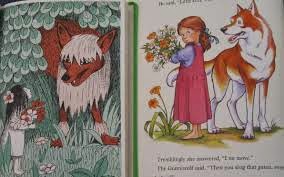
The Gunny Wolf is a perfect example for kids this age.


2)  From about third grade to fifth grade I tell 'scary stories for kids who just 'think they want a scary story, but not really'.  

This group actually thinks they want to be scared, but beware, for if you actually scare them, you will get phone calls from angry parents, principals, and teachers.  Jump tales are the name of the game with this crowd.

These kids are on the precipice that leads from the fears of young childhood i.e. monsters in the closet, things under the bed, creepy creatures waiting to spring out and grab them, and the beginnings of peer pressure fears about being teased, left out, and other more real world concerns.

There are plenty of great ghost type stories for this group.  Many traditional tales will serve.  They can be silly, a little creepy, have a jump or two, but don't do anything exotic...unless you have permission, or you don't mind adults freaking out on you.

Here is some Red, Red, Lips


Borrowed Black


Here are the tales I tell to this group most of the time.  A Little Shiver, not a great big scare.


I am sure you have plenty more!  If you want to share stories you tell in the comments section, it would be helpful for people who are just looking for stories.  You can also head over to Catch the Story Bug and go through Karen Chace's blog for more tales.


3)  Sixth grade is the first year I tell really scary stories.  Using lots of vocal technique and wild facial and body positions can make these stories really creepy, and they can benefit from some lighting.  This is the first group of kids who will probably not wake their parents, and demand to sleep in their bed, so it is safe to scare them. 

The rule I use with this group is that I try very hard to monitor what is happening, and if they get too scared I back off a bit.  They may be in large bodies, but they are still children.  The Boo Hag is a good tale for this group.

My version of The Boo Hag is on my CD Cup Of Blood.  You can download individual tracks if you are of a mind.


Want something scary?  Try Cup Of Blood


4) Once you get into high school, anything goes and you can tell those stories that are not fit for man nor beast.  Scare 'em.  Tell those stories that will peel the skin off of their hides, and make them look both ways when it gets dark.  Pull out your worst stuff and let it rip...unless you are in a school that makes a point of telling you how sheltered and innocent their students are.  If you get that song and dance from the person booking it, pull everything back a notch.  No matter how into the stories the kids might be, the grown ups will be in a faint and clutching their pearls if they think you've exposed their precious charges to something inappropriate, and they may never invite you back.  Appeal to your audience but remember who is paying your way.


5) Intergenerational audiences should probably stay in the 3 - 5th grade range unless you don't have any really young members of the group, then you can go with the sixth grade tales.  If you have an all adult audience let the blood drip, I say.


One of my favorite stories about a scary story set was one I did in upstate New York.  The guidance counselor took these two very big, somewhat disrespectful, tough looking boys out of the main body of the  audience, and made them sit with her.

 After the telling of The Lover's Promise, the guidance counselor came up to me trying not to laugh.  She said, "Did you see those two boys I had sitting with me?"  I nodded.  "When you asked if there was anybody who wasn't scared of anything they raised their hands.  After the story was over, one turned to the other and said, "I only jumped twice, how many times did you jump?"

The story I told them is called, The Lover's Promise, written by my son when he was just ten.  Here is a retelling of it.  It is a long story, fair warning!


Spooky stories require us to walk a fine line between what is appropriate and what is too much.  For some listeners, anything is too much, and for others, nothing is too much.  You can't please everyone, but these stories should also be fun, not just hair raising.

Get behind their eyeballs and they won't even remember whether the lights were on or not.

Happy Spooky Telling!

Saturday, October 18, 2014

Vacation -

I'm in upstate New York. Stop. Visiting one of my oldest friends. Stop. Going to see the Book Of Mormon this afternoon. Stop. Have a great week. Stop.

Happy Relaxing!

DW