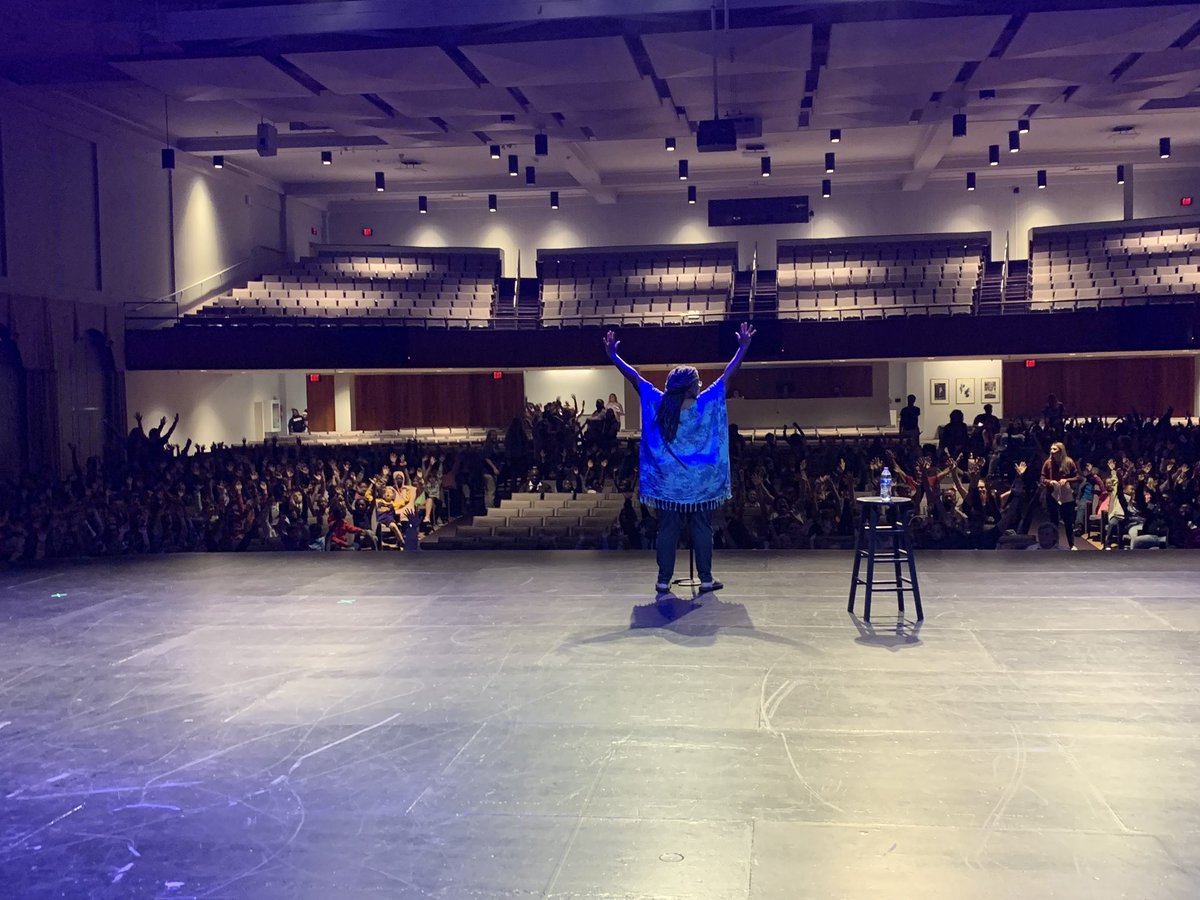
The work has come back with a vengeance, and I am telling all over the country in lots of venues. I am loving live audiences. I am in front of lots of children of all ages!
When I first enter a school, I ask a few key questions so I can get a feel for what I am in for with the students.
"Tell me about the kids."
"Does your school have any major concerns?"
"What are you most proud of?"
"How is your literacy rate?"
"What kind of arts programs do you have?"
It is a basic set of questions designed to get me to a set of stories that is going to be best for whatever group I'm about to see.
Since returning to touring, I have added a new set of questions:
"Have you noticed any difference in your students since returning full time?"
"How are students adjusting to being back in school?"
"What sorts of behaviors are you noticing?"
Some of the things I've been told are expected. Students were home on technology for a while. They could lay down, eat, walk around, and do any number of things while online. They have been with family 24/7 and they couldn't get away from them for over a year or more.
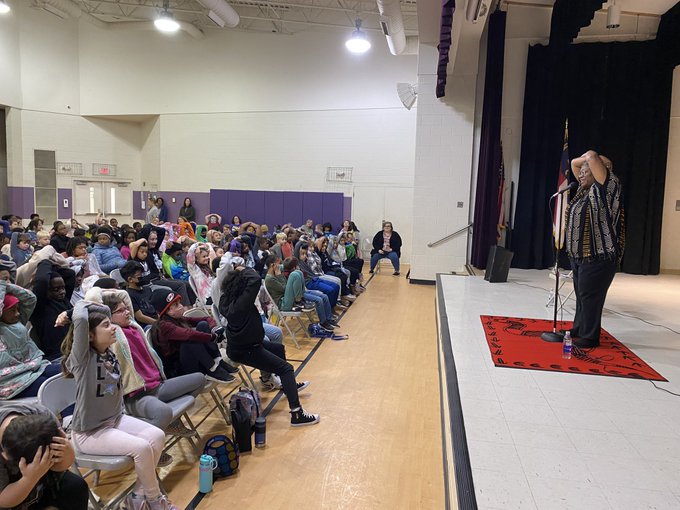
Studentes were with parents or grandparents. Their needs could be met pretty quickly, and some households have neither structure nor discipline. Some homes have too much discipline. Some are running free!
Taking students out of those situations as they are developing and dropping them back in school has caused some interesting issues to appear -
Administrators Say:
- Students are much less mature
- Students have more issues with anger

- Students don't know how to keep their hands to themselves
- Students are not great with personal boundaries
- Students don't know how to socialize
- Students don't listen well
- Students aren't sitting well
- Students are having far more problems focusing
- Students are less patient
The above list is for all schools no matter the socioeconomic status of their population.
It should surprise no one that schools which typically have less funding or service populations that are not as affluent were suffering through extra layers of problems.
The main problem rural schools seem to be facing is attendance. Apparently, if school is online for a couple of years, there isn't much reason to attend. Parents have been taking the kids out of school or just not bothering to send them.
They have gotten out of the culture of schooling. This is affecting everyone from Kinders all the way through highschool. In fact, it was a highschool administrator that first brought it to my attention.
Apparently, having children in school cramps the parent's style if they have something else they want to do. So, they just take them out of school whenever or don't send them at all.

These kids are falling further behind.
Today, I had a long discussion with a child psychologist who told me that she had been in charge of technology when she first got a job here in NC. This was right before the pandemic.
They had the following issues -
1. Most of the students did not have Chromebooks. In Wake County (our capitol county) every student has one provided by the district. this was not true in some of the poorer districts.
2. The state moved swiftly to try to rectify what has been a huge problem that nobody was really dealing with until everyone had to go virutal.
3. When everyone got a Chrome Book - and the process for making that happen in these rural and poor counties was a nightmare - the next problem arose.
4. Many of the households had no internet access.
I assumed wrongly that most people had some kind of access. The world is full of smartphones, right? I have heard so many people say "every three year old can work an iPad". That has certainly been true of my neices and nephews. What I failed to realize is that internet access is still privileged, and lots of people don't have the option or the money to connect. In some places, there isn't any infrastructure so you can't connect even if you want to. There are swaths of our population who do not have access to the digital world.
Spectrum stepped in and tried to get some kind of boxes to each home that didn't have access to pick up connectivity and give these kids a fighting chance, but it was hit and miss at best. Most families with Kindergartners gave up.
There are holes in our systems that were glaring, and we as a country were caught with our privilege blinders on.
There are still glaring holes, and we as a society don't seem to be all that keen to deal with them. Well, that discussion is for another post.
Needless to say, the kids who struggled with connectivity have a whole other set of problems to deal with.
The COVID kids are going to have many hurdles in their future. I wonder how we are going to deal with this as they matriculate.
As for me?
Well, my performance has changed a bit. I am leaning in and letting the kids tell me what they need. How much interaction? How much discussion? What stories do they need?
I learn with every show.

There are some things that haven't changed.
At the end of the story set I hear these comments
Kid - You're not a storyteller, you are a comedian!
Kid - You are the best storyteller in the whole world
Kid - You're going to be my new background
Kid - I've also been to - Whatever state, country, or place I mentioned in the storytelling
And there is the hugging.
I am getting them from kids of all ages...even fifth graders, middle school kids, and high school students. They all want physical contact. Even some of the adults are hugging me. That's new.
Qutoes from adults -
Adult - Wow. I have never seen them that focused
Adult - You really held their attention
Adult - i think I enjoyed that more than the kids!
Adult - I never expected them to sit that long
Adult - They were participating and everything
Adult - You're really good at this!
Adult - Thank you! We needed this.
Adult - I can't believe the Pre-K stayed the entire time
My stories have a different rhythm. I am looking for different kinds of participation. I am letting the audience resculpt the tales so that they can get what they need.
We are all recovering. One story at a time.
Happy Telling!