http://donnawashingtonstoryteller.blogspot.com/2014/10/peninnah-schram-gathering-sparks.html
Tuesday, October 28, 2014
Peninnah Schram: Gathering the Sparks
http://donnawashingtonstoryteller.blogspot.com/2014/10/peninnah-schram-gathering-sparks.html


Monday, October 20, 2014
Just In Time For Halloween: Telling Spooky Tales 2.0
 |
| (Scary Pumpkin Fellow Photo Credit) |
- There are lots and lots of wonderful spooky tales that you probably ought not tell young children.
- There are lots and lots of wonderful spooky tales that you probably ought not tell in the dark.
- There are lots and lots of wonderful spooky tales that you probably ought not tell in certain religious settings.
- There are lots and lots of wonderful spooky tales that you should tell every chance you get.
How do you pick which is which and when you should do what?
Easy! Depends upon who is in your audience.
 |
| (Hint: This is not a hardcore audience member!) |
For starters, you can guarantee that most children between second and tenth grade think that what makes a story scary is telling it in the dark. This is not actually true. What makes a story scary is how well you get inside your audience's head.
If you can freak them out behind their own eyeballs, you could be standing inside the sun, and they would still be scared out of their wits...provided you weren't all burnt alive.
Here are some quick rules of thumb I use when choosing ghost stories for audiences.
1) When dealing with really little kids, the stories should be way more funny than scary. Usually, it is enough to tell the group that you are going to tell them a scary story. Their imaginations will do the rest. They will see 'scary' written in each element of the story right up until the time you make it funny. They may announce afterwards that they weren't scared, but if you look into those giant, nervous eyes while you are setting up the tale, you will see that they aren't all that anxious to be frightened despite the bravado. These kids do not want to be scared!
1) When dealing with really little kids, the stories should be way more funny than scary. Usually, it is enough to tell the group that you are going to tell them a scary story. Their imaginations will do the rest. They will see 'scary' written in each element of the story right up until the time you make it funny. They may announce afterwards that they weren't scared, but if you look into those giant, nervous eyes while you are setting up the tale, you will see that they aren't all that anxious to be frightened despite the bravado. These kids do not want to be scared!
The Gunny Wolf is a perfect example for kids this age.
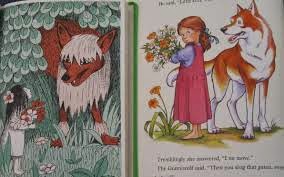
2) From about third grade to fifth grade I tell 'scary stories for kids who just 'think they want a scary story, but not really'.
This group actually thinks they want to be scared, but beware, for if you actually scare them, you will get phone calls from angry parents, principals, and teachers. Jump tales are the name of the game with this crowd.
These kids are on the precipice that leads from the fears of young childhood i.e. monsters in the closet, things under the bed, creepy creatures waiting to spring out and grab them, and the beginnings of peer pressure fears about being teased, left out, and other more real world concerns.
These kids are on the precipice that leads from the fears of young childhood i.e. monsters in the closet, things under the bed, creepy creatures waiting to spring out and grab them, and the beginnings of peer pressure fears about being teased, left out, and other more real world concerns.
There are plenty of great ghost type stories for this group. Many traditional tales will serve. They can be silly, a little creepy, have a jump or two, but don't do anything exotic...unless you have permission, or you don't mind adults freaking out on you.
Here is some Red, Red, Lips
Here is some Red, Red, Lips


Here are the tales I tell to this group most of the time. A Little Shiver, not a great big scare.

I am sure you have plenty more! If you want to share stories you tell in the comments section, it would be helpful for people who are just looking for stories. You can also head over to Catch the Story Bug and go through Karen Chace's blog for more tales.
3) Sixth grade is the first year I tell really scary stories. Using lots of vocal technique and wild facial and body positions can make these stories really creepy, and they can benefit from some lighting. This is the first group of kids who will probably not wake their parents, and demand to sleep in their bed, so it is safe to scare them.
3) Sixth grade is the first year I tell really scary stories. Using lots of vocal technique and wild facial and body positions can make these stories really creepy, and they can benefit from some lighting. This is the first group of kids who will probably not wake their parents, and demand to sleep in their bed, so it is safe to scare them.
The rule I use with this group is that I try very hard to monitor what is happening, and if they get too scared I back off a bit. They may be in large bodies, but they are still children. The Boo Hag is a good tale for this group.
My version of The Boo Hag is on my CD Cup Of Blood. You can download individual tracks if you are of a mind.
My version of The Boo Hag is on my CD Cup Of Blood. You can download individual tracks if you are of a mind.
 |
| Want something scary? Try Cup Of Blood |
4) Once you get into high school, anything goes and you can tell those stories that are not fit for man nor beast. Scare 'em. Tell those stories that will peel the skin off of their hides, and make them look both ways when it gets dark. Pull out your worst stuff and let it rip...unless you are in a school that makes a point of telling you how sheltered and innocent their students are. If you get that song and dance from the person booking it, pull everything back a notch. No matter how into the stories the kids might be, the grown ups will be in a faint and clutching their pearls if they think you've exposed their precious charges to something inappropriate, and they may never invite you back. Appeal to your audience but remember who is paying your way.
5) Intergenerational audiences should probably stay in the 3 - 5th grade range unless you don't have any really young members of the group, then you can go with the sixth grade tales. If you have an all adult audience let the blood drip, I say.
One of my favorite stories about a scary story set was one I did in upstate New York. The guidance counselor took these two very big, somewhat disrespectful, tough looking boys out of the main body of the audience, and made them sit with her.
After the telling of The Lover's Promise, the guidance counselor came up to me trying not to laugh. She said, "Did you see those two boys I had sitting with me?" I nodded. "When you asked if there was anybody who wasn't scared of anything they raised their hands. After the story was over, one turned to the other and said, "I only jumped twice, how many times did you jump?"
The story I told them is called, The Lover's Promise, written by my son when he was just ten. Here is a retelling of it. It is a long story, fair warning!
Spooky stories require us to walk a fine line between what is appropriate and what is too much. For some listeners, anything is too much, and for others, nothing is too much. You can't please everyone, but these stories should also be fun, not just hair raising.
Get behind their eyeballs and they won't even remember whether the lights were on or not.
Happy Spooky Telling!
Saturday, October 18, 2014
Vacation -
I'm in upstate New York. Stop. Visiting one of my oldest friends. Stop. Going to see the Book Of Mormon this afternoon. Stop. Have a great week. Stop.
 Happy Relaxing!
DW
DW
Thursday, October 9, 2014
The Luscious Green Grass in Beth Horner's Garden: Storytelling Is Too A Competition!

We may have done future professional storyteller's a disservice by shouting 'everyone can be a storyteller'! Not because everyone doesn't have a story to tell, they do, but because not every one of them is going to be able to hang out a shingle, and become a professional storyteller.
It takes time to establish yourself in this field.
It can take years to build up a reputation so that you can work enough to support yourself, your spouse, your children and your pets.
Then there is the work itself, which can be quite grueling at times.
Then, and this is the part we don't talk about much at all, there is all of the competition.
Yes, there is competition in the storytelling world, but it takes on a different aspect than in other art forms.
For starters, you are not competing for the same parts. Unlike theatre where there are only seven parts, and the director makes the decisions based on what they see in their heads, the field is much more open and the players can take on many different aspects.

There are hundreds of festivals all across the country, and they are all looking for tellers. Chances are there is one out there for you if you go looking.
It isn't like Broadway where there are only a few big theaters, and you are trying to sell out every seat in the house, and make money for your backers or they will close you down.

Heck, you can tell stories to tiny audiences for years and years and years. Nobody is going to come and announce that because you can't draw more than fifty people at t a time, you are no longer going to be allowed to tell stories. We aren't competing for audiences.
It isn't like we have a Grammy award equivalent where storytellers are awarded best story, best folktale, best personal tale, best...you get my drift.
Authors put out books, and then their works are pitted against each other for awards all over the country.
Incidentally, Congratulations are in order for Bil Lepp whose book, The King Of Little Things, just won a Pen award.

Storytellers don't really have that either. Well, you can apply for a Storytelling World Award, but they give out way more than just one. Your work is evaluated on the merits of its worth, not on whether or not it is better than someone else's work.
So, where does this competition come from then?
Go get a mirror. You see that person? That person is your competition.
Work to be better than the person you are looking at in that glass.
When I put a new story together I am not trying to figure out how to be:
funnier than Bil Lepp
more soulful than Carmen Deedy
folksier than Donald Davis
more tuneful than Diane Ferlatte
more socially aware than Michael McCarty
I grapple with the tale, my style of telling, my understanding of the story, and how much I like the material; not what any other teller in the world might be doing in that moment.
I ask some simple questions.
1. What does this story need from me in order to be successful?
2. What does the audience need from this story in order for this to be successful?
3. What does the audience need from me in order for this story to be successful?
4. What does this story need from the audience in order to be successful?
5. What do I need from the audience in order for this story to be successful?
I answer those questions, and I've got a story I can tell.
Will it be 'better' than someone else's? Not why I tell that story. I picked the tale, I tell the tale, I stand behind the tale, and I've got to love the tale. If I don't love it, I shouldn't be telling it regardless of whether or not I think it is a 'good' telling. That's just my opinion of course, do whatever you like.
I was having dinner with the incomparable Beth Horner the other night after the Wake County Storytelling Festival. Beth has been a dear friend of mine for over twenty years. She is also one of my early mentors in the field. I always love seeing her.

Beth started telling me about what some other storyteller was up to, and I got that wistful look on my face.
I said, "I wish my career was that exciting."
Beth looked at me, picked up a piece of paper, and threw it across the table at me. She started carrying on about how ridiculous it was for me to make that statement considering all of the things I was doing. Then, to my amusement, she began complaining about her own career, then, stopped and started laughing.
I noted that it isn't possible to do everything, and take advantage of every opportunity, and it always seems like somebody else is doing something more exciting, interesting or fascinating than you.
Beth nodded, "Yes, even in storytelling the grass is always greener."
So, the next time you begin to wonder why you haven't ever been featured at Jonesboro, or why you only did fifty schools last year, or why you don't do more work in libraries, or how come Mr. X is always at place Y, and you haven't even been there once...take a deep breath, look in your mirror, and consider all of the beautiful, luscious green grass behind you. Consider the fact that somewhere out there is another person looking hungrily at that grass, and wondering what you did to get such good, sweet stuff.

Then, put the mirror down and get back to work!
The competition you face is too stiff to sit around wondering what someone else might be doing.
Happy Telling!
Monday, October 6, 2014
This is a Non-Post: It Is My Birthday...and I'm Kinda Busy

No new post last week.
Now new post his week.
Working on short fiction.
Working on long fiction.
Putting together presentations.
Can't think of anything all that exciting, interesting, or worth the time to write it up for public consumption.
My daughter has the week off so she's learning lines for her role as Anne Frank in the Diary of Anne Frank and I'm helping.
Besides, today is my birthday.
Not posting again until next week.
Sometimes, it just has to be that way.
Happy Living!
Thursday, September 25, 2014
TV Head Audiences: What Are They and How Do You Crack Them?
 |
| photo Credit |
There is a very odd thing I see in audiences. I spent the first part of my career looking at it and trying to understand it.
What am I talking about? I call them the TV Heads.
TV Heads have obviously spent lots of time in front of a screen where their behavior has zero effect on what will happen during the course of the time they are plunked there.
They have been trained to sit and stare at 'entertainment' without registering anything. They are staring at you, and it looks like nobody is home the same way they stare at screens that are not video games. You may have encountered this phenomenon. Most audiences have at least one or two.
If you turn off the television while one of the TV Children is watching, they will complain, but may be completely unable to tell you what they were just watching.
Combine this with a situation where they do not often see live performers, and you end up with an odd combination of behaviors.
Many years ago I did a show in a library in Miami that serves a low income community. There were metal detectors and an officer stationed at the door to the community center in which this library was housed. The meeting room filled to bursting with family units, elders who'd come alone, and unaccompanied children between the ages of seven and ten. In the back of the room was a table covered with cookies, snack bags of chips and cold lemonade.
With few exceptions, this inter-generational audience stared at me in blank silence for the entire performance. I was working as hard as I could to get some kind of response, and it was not forthcoming. It was the longest show of my entire career as a standing room only crowd made absolutely no sound, didn't smile, and barely applauded between the stories. When it was thankfully over, the bulk of the audience turned and made a mad dash to the treats that were on the table in the back of the room. Clearly they had come for the free food, not the stories.
I sank into the chair covered in sweat feeling both defeated and a bit like a zoo exhibit of an odd animal that nobody could identify.
The librarian came up to me and said, "That was wonderful!" I thought she was being polite.
Then, a woman in the front row who had nine stair step children came over to me with her youngest in her arms, bent down and whispered, "We never leave our house. This is the first time we have ever come to the library. We will come back." She gathered her stairs step children...who walked in descending order of height after her, and left in complete silence.
Cookies and punch in hand, children rushed the stage to share how much they enjoyed the tales. Adults did the same, smiling and waving as they left. At the time, I had no idea what had just happened. Apparently, they'd spent forty-five minutes watching some kind of video together. You're not supposed to make any noise at the movies. It's rude.
How can you identify TV Heads in your audience?
1. No affect - TV Heads tend to have very blank faces when watching something. They don't smile or laugh or frown. The idea that their expressions will have some effect on what is in front of them is foreign.

2. Face on hands - Fists or hands on their faces such that it would be impossible for them to speak. They are not in any position to actually participate in the activity at hand.
3. They are in their living room - These audience members treat you like a video. They sometimes maintain a low buzz of conversation the entire time to you perform without understanding that their behavior will have any impact on you. I've had kids get up and come and stand right in front of me while I'm telling. They are not being rude...well they are, but actually all they are doing is behaving the way the would if I were a television.
 |
| photo credit |
4. Lack of Participation - These audiences are completely oblivious to the interacting elements. If you watch Dora the Explorer, you know that whether or not you participate with that cute little brown cherub, she will continue on as if you did. These audiences are so busy staring they often participate a beat behind, or they only partially engage their bodies even though they are paying attention.
I am not saying they don't enjoy the event, they do. They are just having trouble bridging the gap between what they are used to and what they are experiencing. They might not make any sound at all the entire time, and they may not crack a smile.

So, how do you get the TV Heads to fully participate? You have to work it.
1. Begin the telling by asking questions of the audience. ex. "How many of you have parents who yell?" This sets up the behavior you are expecting, and it will help some of them start less passively. This also builds rapport, and gives everyone a place to begin.
2. Check in with the audience during the set and allow for their input to help shape the stories every now and then. ex. "Does anybody know what animal ham comes from?" (My favorite answer to this one was lion.) Checking in with the participants makes sure they are still with you, and assures them that even though they are watching, their participation is still part of the event.
 |
| Lausanne School in Memphis, TN...Workin' it! |
3. Come up with questions that relate the story back to their current lives. example: 'How many of you have ever been dared to do something you know you are not supposed to do?" This is one of those, 'just raise your hand' moments. This might occasion the listeners to turn to someone next to them and share a quick story or even a word or two. Allow for the bit of chatter before you go on with the tale. Helping the audience put themselves in the middle of your story makes it personal for them.
4. Find humor in the things they do. "How many of you know a boy who falls out of his chair for no particular reason? Don't point, it's not nice!" Allowing the audience to laugh or point at themselves or acknowledge that they are living in pieces of the tale in the moment keeps them actively engaged. They might go back to sitting passively after the moment, but usually they retain a bit of a smile. That expression is better than the blank one!
It doesn't work with all of them, and we all feel keenly the ones we can't reach, but these steps give you a good chance!
The more you can get audiences to rethink what their bodies are doing, keep their brains working in the moment, make them contemplate things going on in their lives, relate to the people around them, and encourage them to play with words, images, and sounds the better chance you have of reaching the TV Heads.
Happy Telling!
Tuesday, September 23, 2014
Story Parenting Teenagers: A Run Of The Mill Conversation.
 |
| Story Parenting adolescents |
Last night at dinner, my husband asked a simple question. “Honey,” he said to me, “What would you like
to do for your birthday?”
“I don’t know.” I
told him, “I haven’t really thought about it.”
“Well, we are going to be celebrating it on the fourth since
you’ll be out of town on the sixth.”
My fourteen-year-old daughter looked up. “What do you mean? She’ll be home most of the week of her
birthday. Why are we celebrating on the
fourth?”
My husband gave her a look.
“What’s the problem? Have you got
something going on the fourth?”
“Yes.” She
replied. “I’m planning to overthrow a
small republic that day.”
There are all sorts of places the conversation could go at
this point. There are all sorts of things the grown people could say. There are lots of options…but this is a home
where there are two gifted and cursed adolescents. All bets are off all of the time.

Both my husband and I looked at my daughter.
My husband said, “Well, you’re going to have
to reschedule.”
My daughter looked put out.
“I can’t just reschedule something like that! Don’t you know how much planning goes into
overthrowing a small republic? This has
been in the offing for months.”
My husband shook his head.
“You could have picked a better week to do it. We have Phantom of the Opera tickets for the
following Thursday.”

“Oh,” my daughter informed him, “that won’t be a
problem. I do most of my work during the weekday.”
“When?” I challenged.
My daughter gave me a cryptic look. “You don’t know where I am all day.”
My husband thought he had her. “Oh, so when we think you are at school you
are not? How did you manage that?”
My seventeen-year-old son piped up. “When I get the call, I put on a wig, scrunch down, and take her place.” He shrugs. “Nobody even notices.” He is six inches
taller than she is, not to mention the other physical differences that definitely mark her as a girl and him as not.
I pounce. “Who takes your place?”
My son waves away my concerns. “We have a nameless, faceless corporation
that takes care of that.”
 |
| photo credit |
My husband attempts to get the situation back
on course. “So, what do you want to do?”
My daughter turns to the corner of the room and says, “Karl,
we have to change the date for the overthrow.”
My son frowns. “How
are you communicating with them? How can
they hear you?”
My husband shrugs.
“You can secure microphones anywhere.”
“Yeah.” My son
agrees, "but how can she hear what they are saying?”
Meanwhile, my daughter has continued to speak to the
corner. “Of course you should call the
Chinese Mafia. Why wouldn’t you?”
My son turns to me.
“I didn’t know the Chinese Mafia was involved.”
 |
| photo credit |
My husband sighs and says, “What do you want to do?”
My daughter is upset with Karl. “Don’t argue with me, Karl! Just move it!”
My husband says. “You
know, we could always just do it on Friday.”
My daughter looks annoyed.
“We just changed the date!
Thanks, dad.” She goes back to
yelling at Karl. Ultimately she suggests they put the whole thing off for three weeks. “Maybe you should
reschedule for the beginning of November.”
My husband sits back in amusement. "Why would you want to overthrow a republic? Why don't you overthrow a dictatorship? Our country is a republic, you know?"
My son turns to me.
“Maybe I should start talking to myself.
Everyone else at the table is involved in a conversation, and I'm starting to feel left out.”
In an attempt to assuage his sad voice, I put a hand on his arm. "I'll talk to you."
My husband takes a deep breath and tries to regroup in the face of the insanity all around him.
In the end, we decide to take a family road trip to either a museum we have not visited, a zoo, or the Biltmore Estate.
 |
| Biltmore Estate |
(Later during the same dinner, we reflected that the phrase ‘train’ of
thought did not adequately describe what goes on in the minds of most of our family members.)
My daughter decided she has a dolphin of thought. That’s a long story that I will not tell at
this point. Let's just say her dolphin veers all over the place and cannot be counted on to get from place to place in any sort of linear fashion.
My son wanted to have a Velociraptor of thought,

My
daughter thought my son should have a slot machine of thought because of how
random he is. I pointed out that slot machines don’t actually move. My husband suggested a pogo stick of thought, but a pogo stick pro can actually go in a straight line, and my son's thoughts haven't ever gone in a straight line in his entire life. Then, we thought perhaps he had a two-headed
snake of thought.

In the end, he decided
he had a Sidewinder of thought.

I have a platypus of thought. I even made up a short story on the spot,
which I shared with my family about why I am the platypus. It went over well, and was accepted.

My husband is the only one of us who has a ‘train’ of
thought. I mean, he is logical, steady,
dependable, and he doesn’t like it when things are not on schedule. We all assured him that this is what we like
best about him. Somebody in our house
needs to be sane since the rest of us are off our rockers. Needless to say, he did not like the idea of
being the only one having a ‘train’ of thought.
He wanted a hover car of thought, but hover cars are way too unpredictable. Ultimately, my husband
went with elephant.
You might ask, “What was happening in your house that day to
cause all of this at one meal?”
The answer? Monday.
Happy Parenting
Subscribe to:
Posts (Atom)